
































































Rukka Nivala 3.0 GTX suit review
Published on: 30 January 2026
CLICK RUKKA NIVALA 3.0 GTX SUIT TO SHOP WITH FREE UK NEXT DAY DELIVERY
The latest iteration of the Rukka Nivala is now here.
In truth, the old one has been around for almost four years, so it was probably due a bit of a refresh, but the decision was in some ways made for Rukka by Gore, who are in the process of changing all their membranes and laminated fabrics.
A new set of outer fabrics and materials means that the entire suit had to be re-tested under EN 17092; and so Rukka has chosen this moment to make a few changes to the Nivala. In truth, the differences between the old Nivala and the new one are quite minor but, as you would expect, we are going to go in to some detail to explain what the changes and differences are.
Anyway, let's get in to it.
The new Gore-Tex laminated membrane
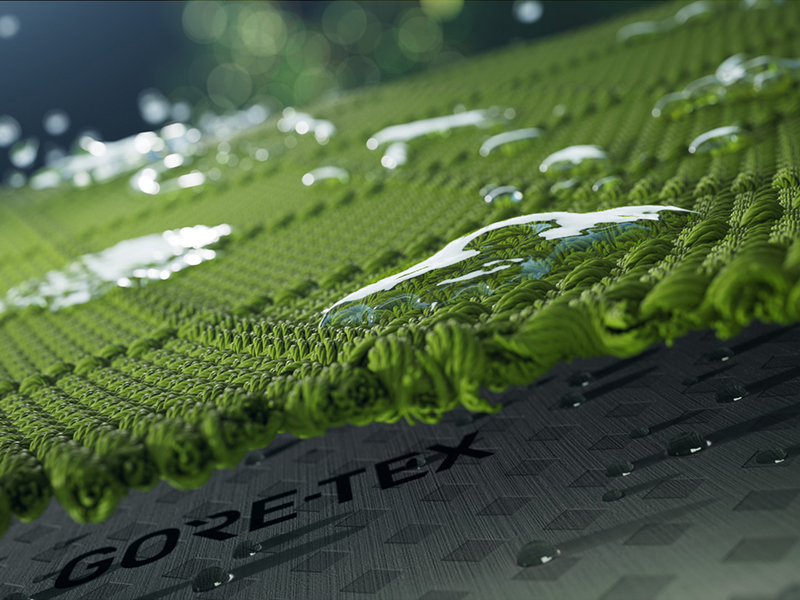
Gore-Tex is a major player in the outdoor pursuits arena. They supply waterproof membranes and materials to just about all of the premium brands. In fact, it's a brand's use of Gore-Tex that often confers upon it that premium positioning.
Being such a significant name Gore is very protective of its brand. They work hard to re-inforce their technical credentials. But they are also keen to be seen as a brand that cares about the environment.
Which is why they are determined to get ahead of the curve when it comes to the use of what are known as 'forever chemicals'. Now Teflon is just such a chemical, and historically Teflon has been incorporated into Gore's, as well as in to everybody else's, waterproof membranes.
In the coming years legislation will outlaw the use of Teflon, but Gore has been working on developing membranes without Teflon for many years. These new membranes have been tested to a degree that allows the company to claim that there will be be no trade off in performance between their membranes that incorporated Teflon and the latest ones that don't.
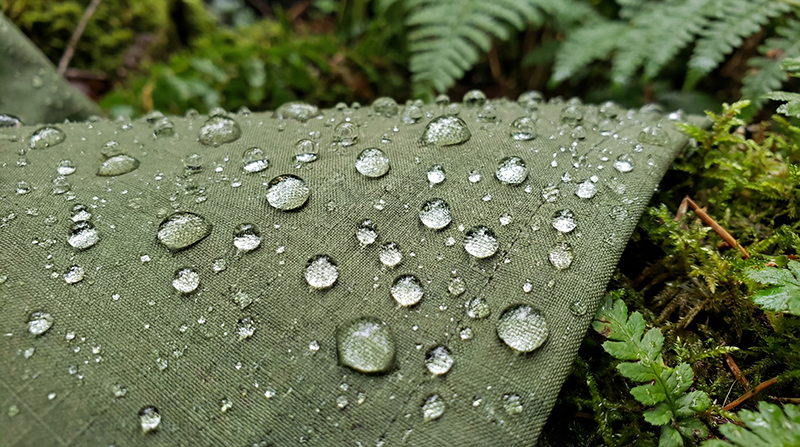
There will, however, be a slight drop off in performance from the new DWRs (Durable Water Repellents). A DWR is the initial barrier to the rain. It is the DWR coating that causes water landing on a garment to bead, and run off. Every waterproof product will have been treated with a DWR; indeed the very simplest ones will sometimes only have a DWR.
But on a garment with a membrane, whether that be a drop-liner or a laminated one, the DWR coating serves to enhance the effectiveness of the membrane by slowing down the absorption of rain by the outer fabric.
The reason that, in future, DWRs will not be as effective is because, historically, they have also contained Teflon. In the future, therefore, DWRs will be slightly less effective. And remember this is not a Rukka or a Gore issue; this is an everybody issue.
Indeed, Rukka is at pains to point out that their membranes will work just as effectively as they always have done. They will still, for example, be guaranteed to be waterproof for life. But in the future, Rukka's garments, as well as everybody else's, may show a slightly greater propensity to 'wet out'.
Now a laminated garment will never totally wet out because the membrane will stop any water passing through the outer fabric, but the fabric itself may well take on more rain than used to be the case. Most people will never ride in the kind of conditions where this becomes an issue.
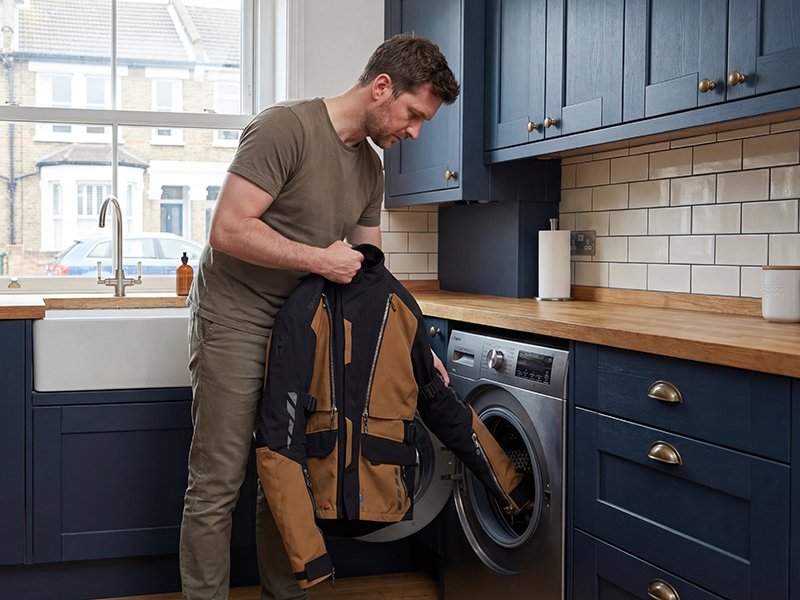
The worst-case scenario is potentially one where the jacket becomes a little heavier, and therefore potentially a little colder, to ride in. For the high-mileage rider the solution will be to wash a garment, and refresh the DWR, a little more frequently.
Anyway, the new Nivala is made using Gore's new ePE membrane rather than the old ePTFE one. And in truth this is why we are talking today about the Rukka Nivala 3.
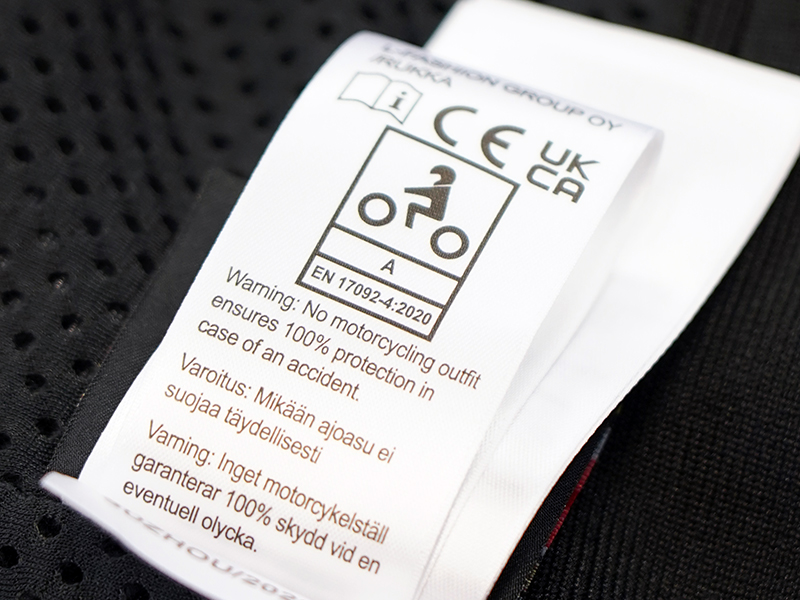
The same, single-A, EN17092 abrasion rating
When it comes to the Nivala I am not sure that it's still pertinent to talk about the garment's abrasion rating as though it's the elephant in the room. After all the Nivala’s been A-rated for nearly 10 years, and it’s still a hugely popular outfit.
There was some talk on social media about whether the new Nivala would be AA rated; and indeed that was the first question we asked when we were told about the Nivala 3, although I have to say that we would have been very unhappy if a higher CE rating had made the Nivala less comfortable.
And that's because there are loads of uncomfortable, AA-rated suits out there; indeed some of them are made by Rukka! What causes the Nivala to stand out from the crowd is its level of comfort. That's what makes it so special.
Some might suggest that, in lauding the Nivala, we are prepared to compromise our customers' safety; but no not really. And that's because the Nivala is still one of the most protective motorcycle suits that money can buy, despite its EN17092 classification.
And for those who don't understand how this can be the case, we are going to explain.
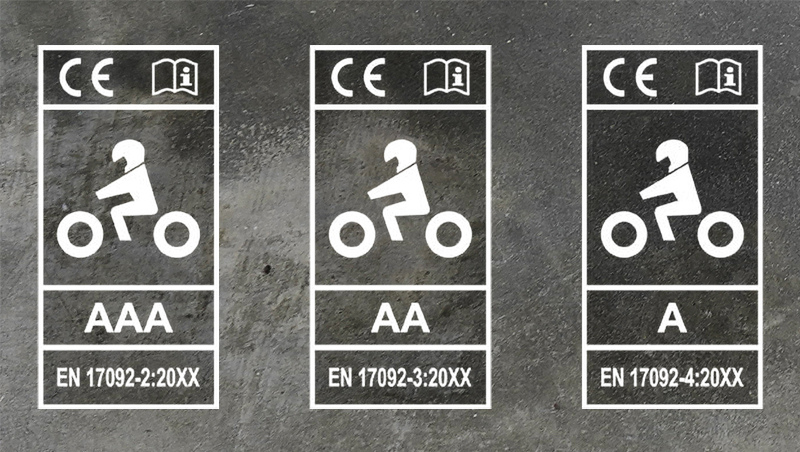
The meaning of EN 17092
Let's get one thing out of the way. We don't have an agenda here, other than wanting to give our customers the best advice on their gear.
We sell all of Rukka's suits, and many of these are AA rated; and if buying a Rukka AA-rated suit helps you to sleep better at night, so be it; that's fine by us. We make no more money on the Nivala than on any other Rukka suit, so commercially we have no vested interest in pushing the Nivala.
But that won't stop us telling you how we come to the conclusion that the Nivala is one of the most protective suits out there, and why it is, in our view, a better suit to ride in than anything else that comes out of the Finnish operation. Or indeed anybody else’s operation.
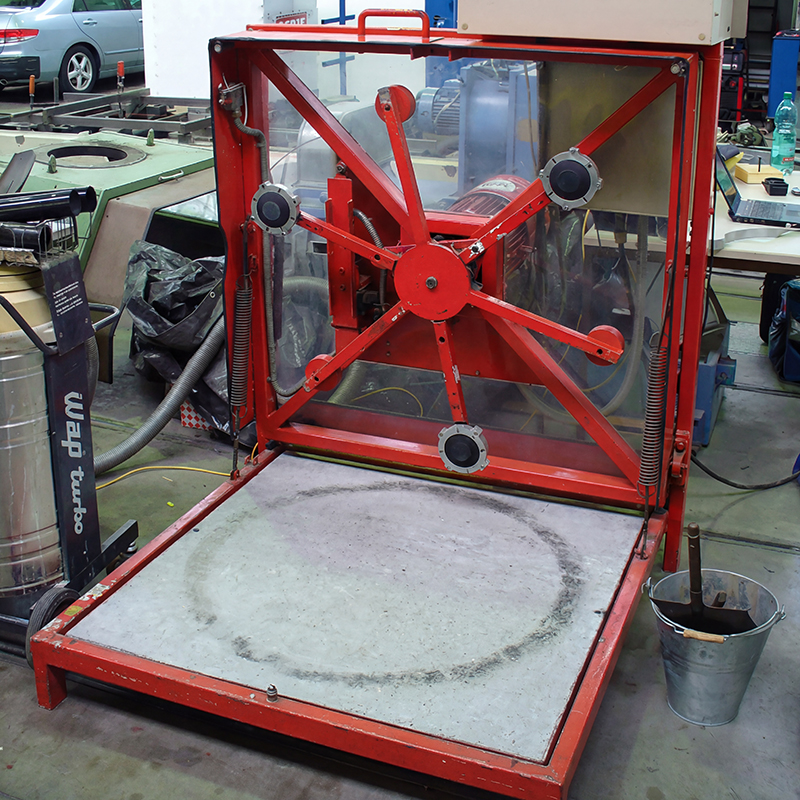
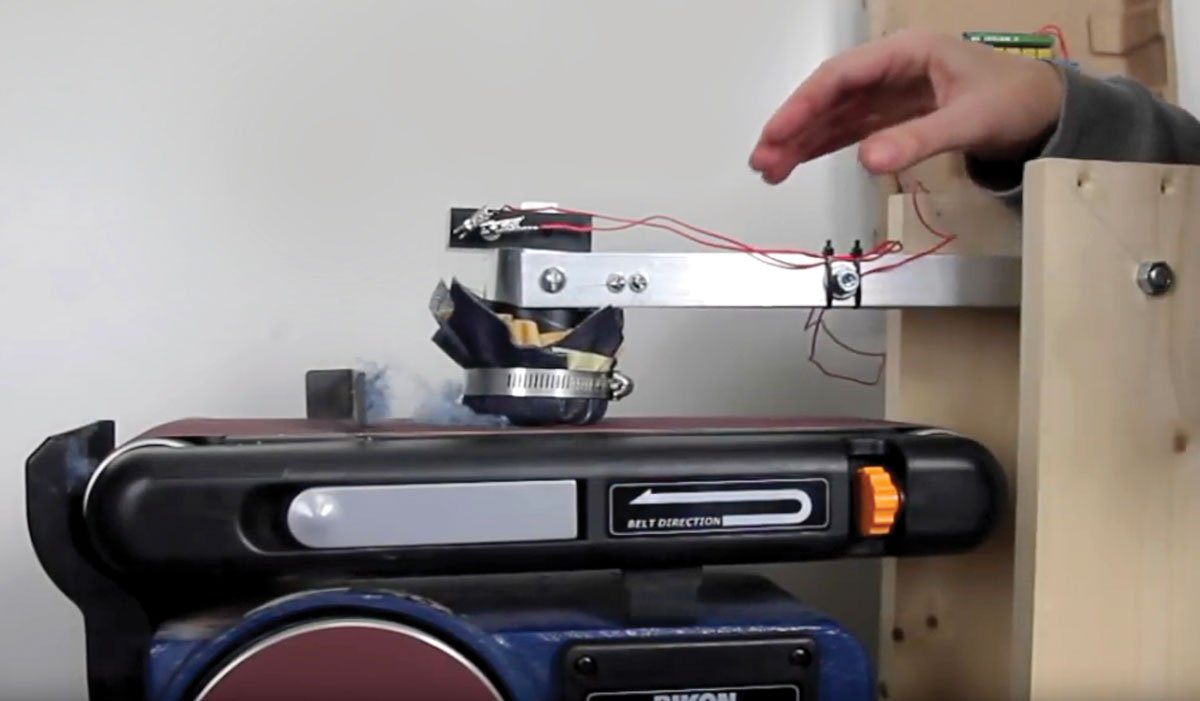
The first thing to grasp is that EN17092 is not a safety standard. The guys at Bennetts love to quote EN17092 as an indication of a product’s protective qualities, but that’s nonsense. The reality is that it's nothing more than a very simple abrasion and tear resistance test; and in fact it's nowhere near as indicative of a garment's outer strength as the test it effectively replaced: EN13595.
Now I don't want to go full-on conspiracy theory here but the truth, acknowledged by all those who were around when 17092 was being developed, is that the protocol was designed primarily as what economists would term a ‘barrier to entry'. This is a hurdle that makes it difficult for brands outside a territory to import goods into a given region. And that’s what EN17092 does. It makes it harder for American, Japanese and Australian brands, for example, to export to Europe. It's the kind of thing that Trump has in mind when complaining about European protectionism! Although he’s one to talk!
The bottom line was, and is, that 17092 is more about saving jobs than about saving lives.
Of course, we are not saying that abrasion-resistant fabrics are not a good thing; they are. But, when it comes to protecting motorcyclists, far more important than a garment's outer chassis is the armour it's equipped with.
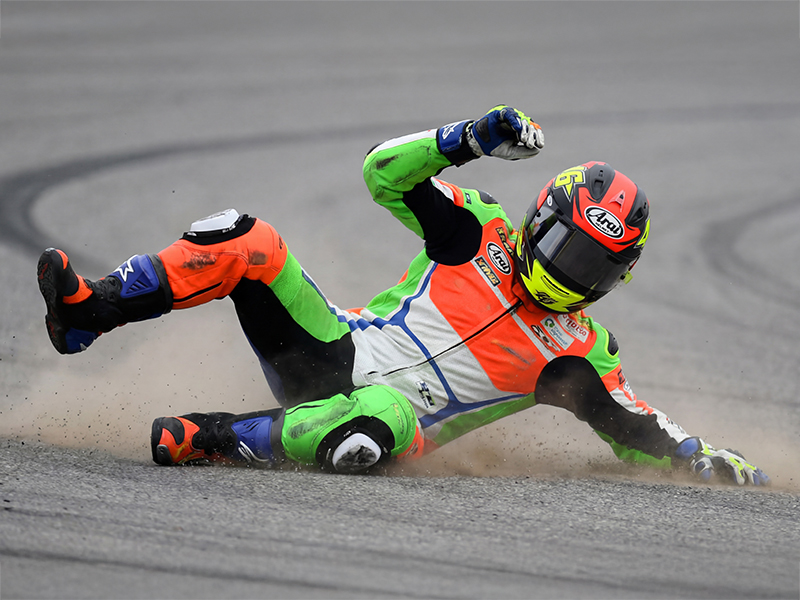
If you come off the bike you may well end up sliding many tens of yards down the tarmac. But on the road, unlike on a circuit, you are rarely going to slide far. You may slide for a short distance, but there's a good chance that, for various reasons, you will roll. And before long you will hit something, like a kerb or a wall. That's just the nature of modern roads, especially here in the UK.
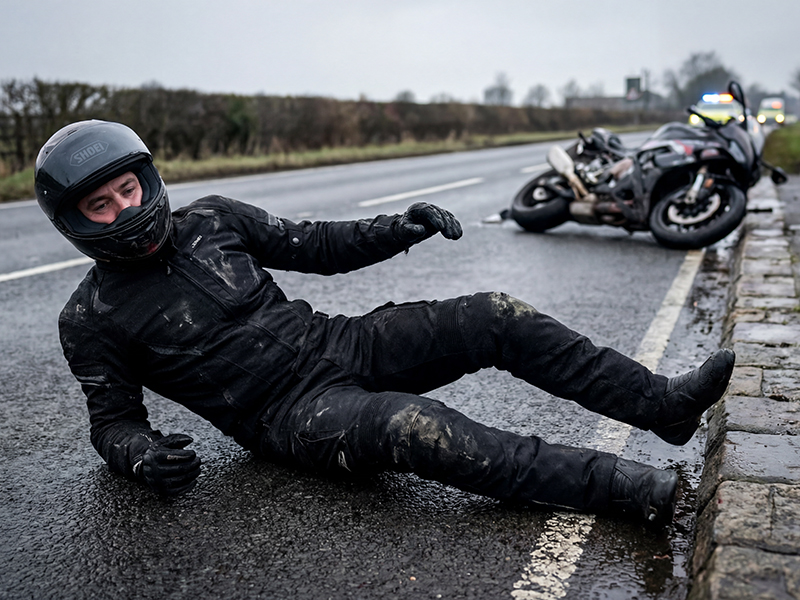
And it's when you hit something that your real troubles begin. Because this is when you can break bones, damage spines and suffer internal injuries. All kinds of other things can go wrong when you come to an abrupt halt. The list of potential problems is as long as your arm. But few of them result from sliding smoothly down the road.
What helps when you hit something is the armour in your jacket and pant. And on this matter EN17092 stays very quiet. The standard makes no mention of Level 1 versus Level 2 armour. It says almost nothing about the size of armour. And it makes no demands in terms of even a back protector, for example. And so, EN17092 will accredit a jacket to the highest AAA level even if it is fitted with the tiniest, Level 1 armour, and doesn’t come with a back protector.
EN17092 is primarily about politics, not protection. It simply isn’t what many people, including Bennetts, think it is!
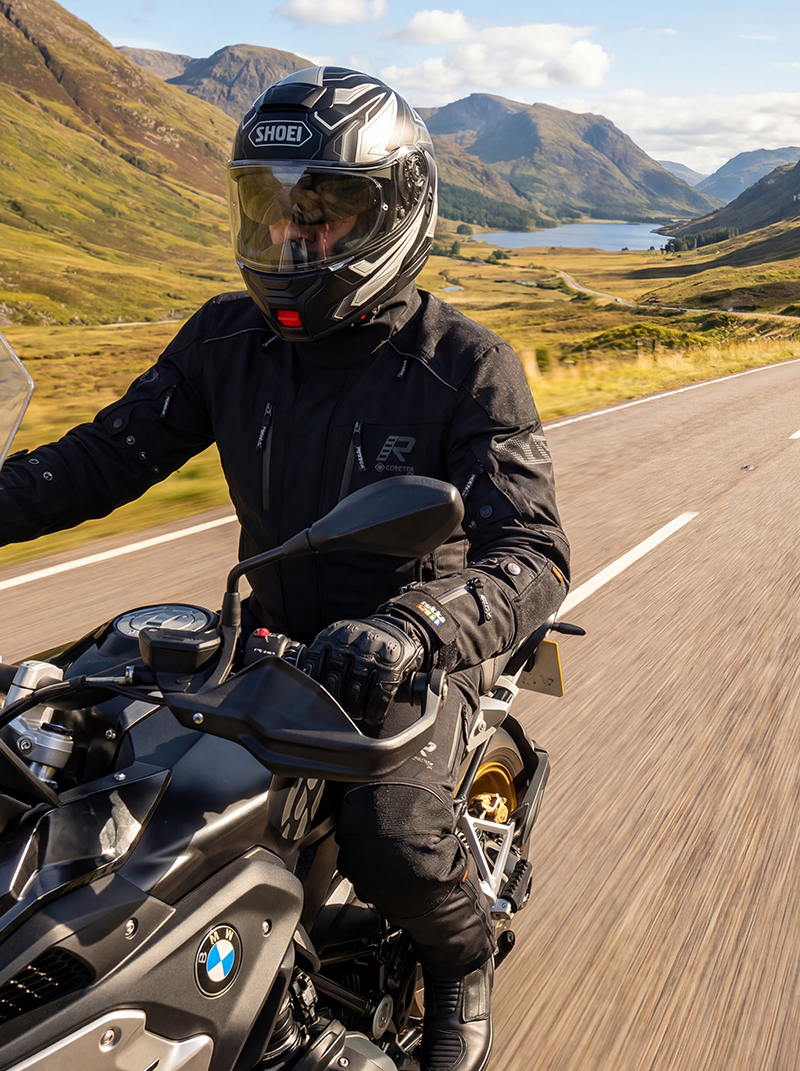
Why the Nivala is such a protective suit
We have already alluded to the fact that armour is potentially much more important than the abrasion resistance of a jacket or pant's outer fabric when it comes to protection.
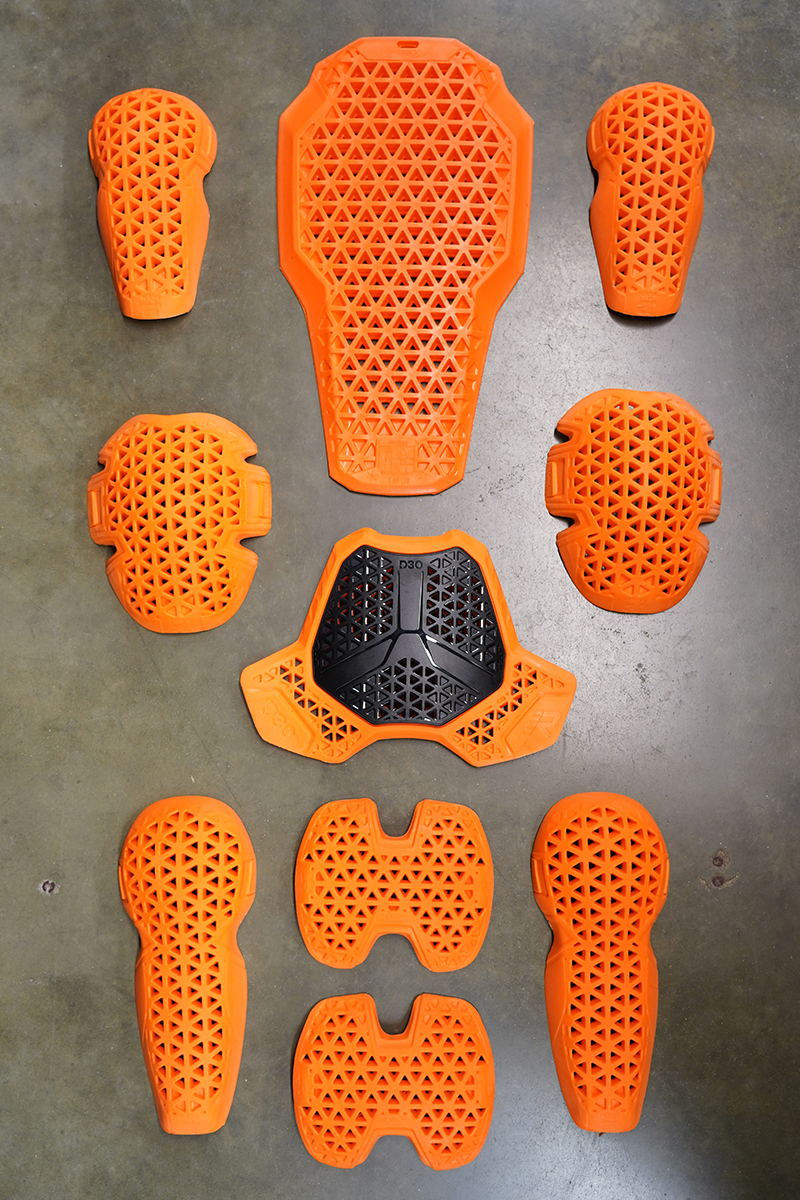
Well the Nivala may only be rated A for abrasion resistance, but it comes with probably the most impressive suite of armour of any motorcycle suit on the market.
The first thing to say is that it's all Level 2, which just to remind you can absorb twice as much energy as Level 1 armour.
But what has to be acknowledged is that not all Level 2 armour is born equal. Some Level 2 armour is tiny. Rukka's bespoke, D3O, Level 2 armour, by contrast, is absolutely huge. And that is important for two reasons.
First, and self evidently, the larger the surface area of the armour the greater is the chance that when you collide with something that object will impact the armour rather than an unprotected part of the body.
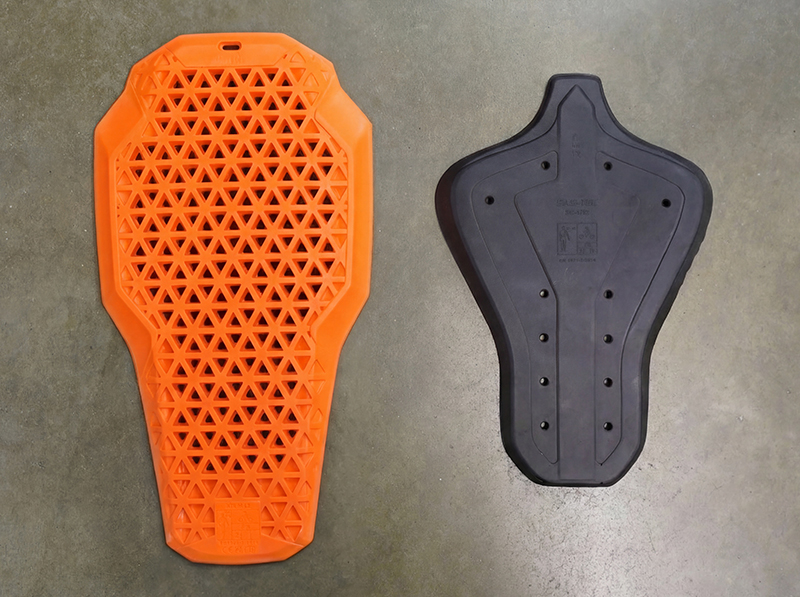
So let us look at the Nivala's Level 2 back protector in comparison with one from say a jacket. It does not take a genius to work out which one you'd rather be wearing when you land on a car's bonnet.
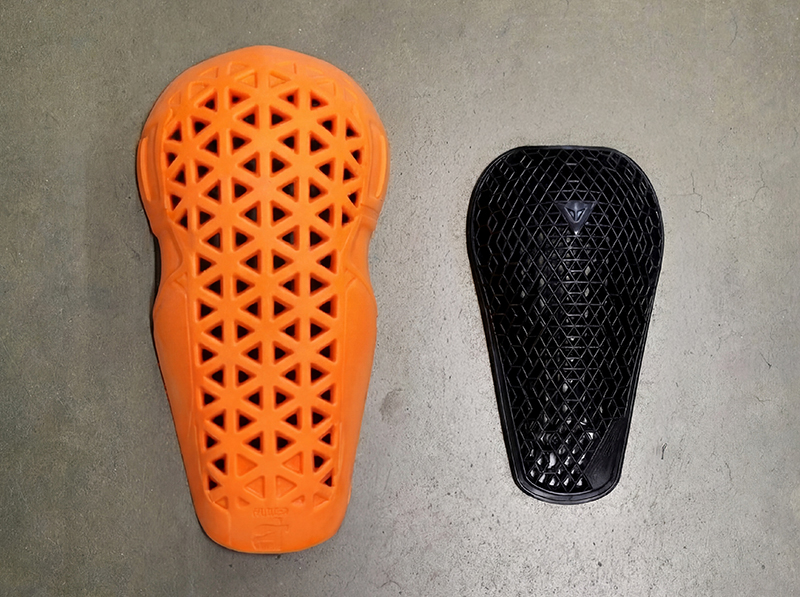
And how about this elbow protector compared to a Dainese one.
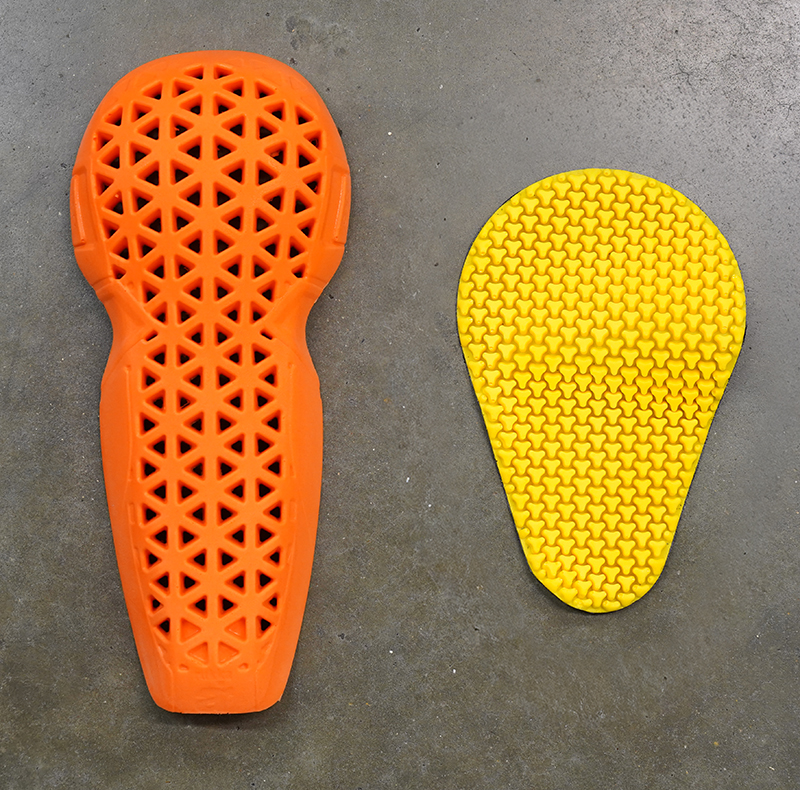
The differential becomes even greater when you take the Nivala's knee protector, and compare it with one produced by SAS-tec.
Bear in mind that many an AA rated suit and some AAA rated suits come with Level 1 armour, but what we can see is that even if something does come with Level 2 armour it's probably not going to provide anywhere near the coverage of the body you get with Rukka's Level 2 armour.
But there's a second part to this story.
Another thing that EN17092 does not take into account is the added abrasion resistance that armour brings to a garment's outer chassis. (Indeed, in one Australian study the authors even went so far as to suggest that this was just as important as the armour's ability to absorb energy).
Yet EN17092 doesn't even reference armour as a contributor to the abrasion resistance equation.
But despite what EN17092 does or does not say we can be confident that any Level 2 armour will make a jacket or pant's outer chassis more abrasion resistant than Level 1 armour.
Imagine, though, the added abrasion resistance that results from Level 2, shoulder, elbow, knee or hip armour that is as large as Rukka's!
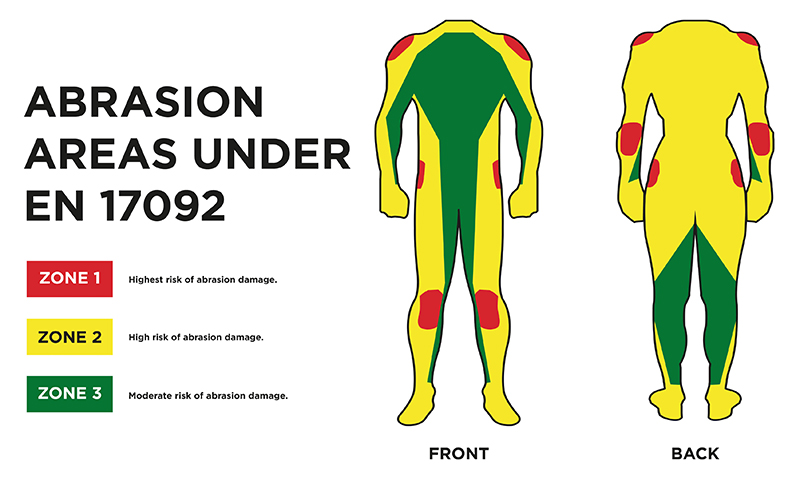
It's going to elevate the abrasion resistance of the Nivala's outer shell in the high-risk Zone 1 areas to a level way beyond that ever conceived of by the architects of EN17092.
Which is why we feel so confident in claiming that the Nivala is one of the most protective suits on the market.
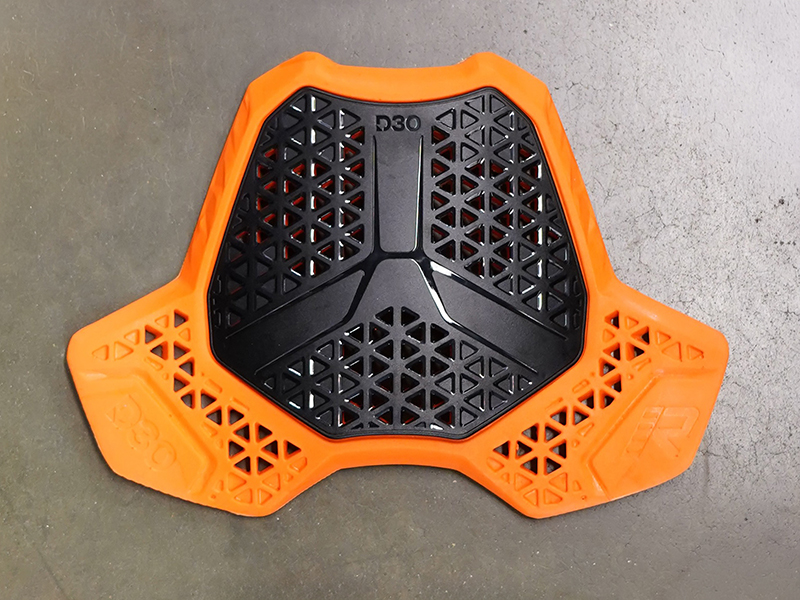
And with the Nivala 3 even more so, as the latest version now comes as standard with a Level 2 chest protector. (I may be wrong on this, but I reckon that this is probably the first ever road suit to come with a Level 2 chest protector as standard!)
In summary, the only suits currently available in the UK that might be considered notionally more protective than the Nivala are Rukka's, AA-rated suits. You will get the same Level 2 armour as the Nivala, but with an outer chassis that is technically more abrasion resistant. Even then, though, you don't get the Nivala's Level 2 chest protector.
But the Nivala, we have to tell you, is a lot more comfortable than any of Rukka’s other suits. And that’s the Nivala’s USP.
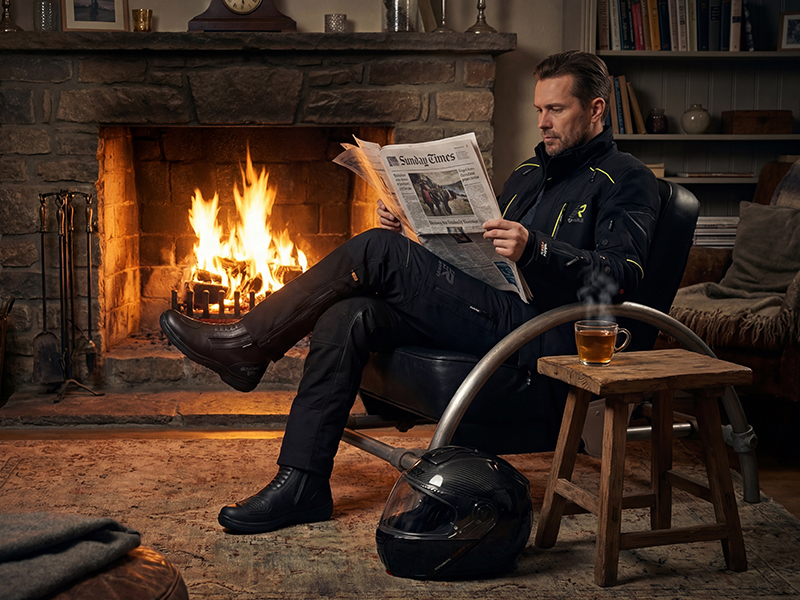
The Rukka Nivala's comfort factor
If the new Nivala had been delivered with an AA rating, but with no trade-off in terms of comfort, it would have become easier to sell. And that's because there are lots of 'box tickers' out there who feel reassured if they can use some kind of quantitative yardstick when purchasing a motorcycle garment.
It saves having to do any real homework, or getting to grips with the issues. These are the people who simplistically conclude that A is poor, AA is acceptable, AAA is good. Whereas, in our view, it's quite often the other way round.
But what we can be fairly sure of is that Rukka came to the view that they could not deliver the same level of comfort if they reinforced the Nivala in the places necessary to pass at the AA level.
And let's be clear. It is the Nivala's comfort that makes it so popular. It’s why it’s the biggest-selling suit in the company's 40 year history. It outsells all Rukka's other 3-layer, laminated suits combined. And people buy it despite the fact that they know its outer fabric is only single-A rated.
We here at Motolegends are big believers in what is known as ‘passive safety’, and if you want to ride comfortably and relaxed in even the worst conditions, the Nivala is the suit to be in.
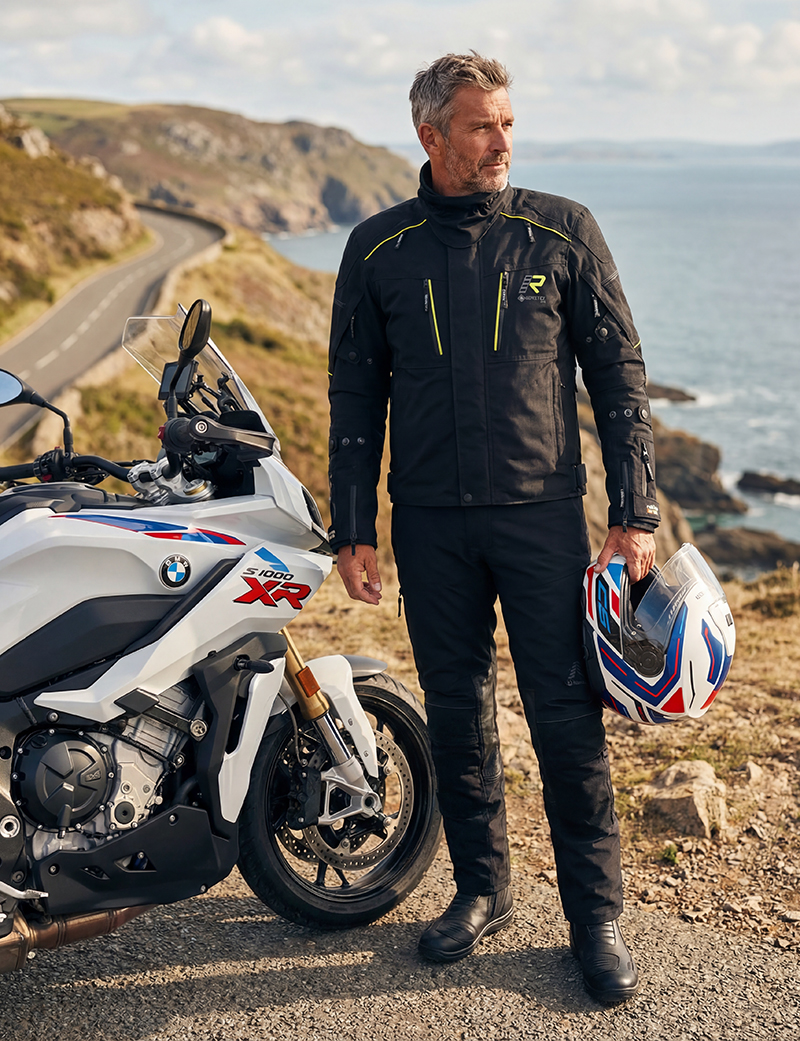
The Nivala 3.0 in detail
We'll talk initially about the jacket, although lots of the technical stuff will relate to the pants too. We will talk about the specifics of the pants once we've finished on the jacket.
The new Nivala's outer chassis is of a 3-layer, laminated construction. The outer, stretchy material. Then the membrane. Then a protective lining. This is known as a Pro-Shell construction. Pro-Shell garments are often quite stiff, but the stretch in the outer fabric of the Nivala negates any such concerns.
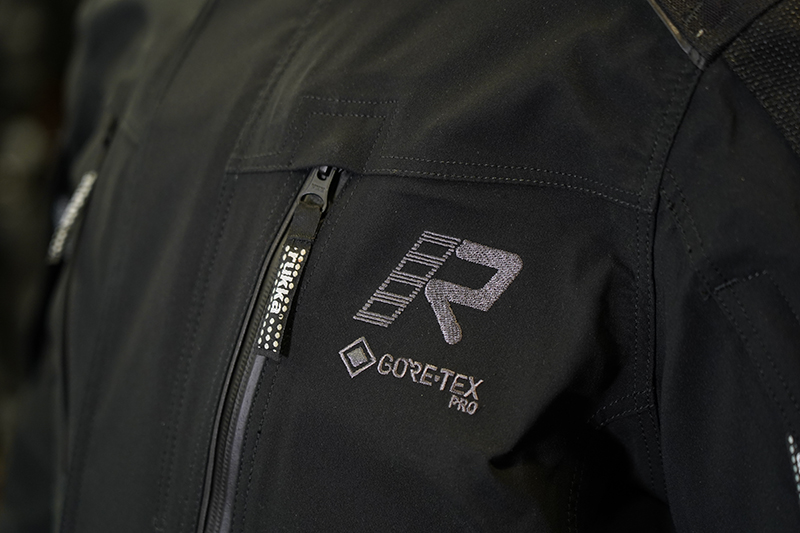
Pro-Shell is Gore's premier membrane. It's their most waterproof. It's their most robust. And for reasons that are too technical for me to understand, it's apparently their most breathable too. (I can't get my head around why it is, but who am I to argue)?

We have already discussed the new ePE membrane, but suffice it to say that you still get a lifetime warranty on waterproofing with the Nivala. And this is the most solid and dependable warranty in the motorcycle, clothing world. If you think a Gore-Tex product leaks, you send it off for testing. If the independent, Gore-approved laboratory says it does leak, Gore will send you a replacement. It’s that simple.
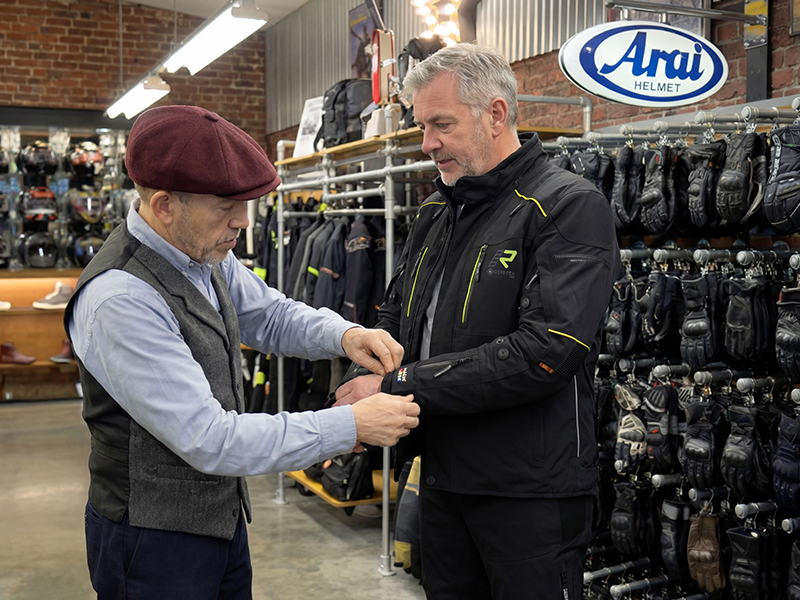
Now the Nivala 3 jacket is not configured in quite the same way as the Nivala 2; and that may be because the 3 has features the 2 didn't have. Certainly, the way the panels are cut is different. What I do not know is whether the new jacket comes from a different block pattern. We tried the 2 and the 3 on back to back, and we kind of thought the new one was a bit more generous. But it's going to take months of customer fittings to really work out whether there’s a significant difference in the way the two jackets fit. It may, though, be unwise to assume that you will be the same size in the 3 that you were in the 2.

Recently, someone from the UK distributor was at pains to point out just how much more attractive and stylish the new jacket was when compared to the old one. Personally, I couldn't see much difference. Put it like this, neither is much of a babe magnet!
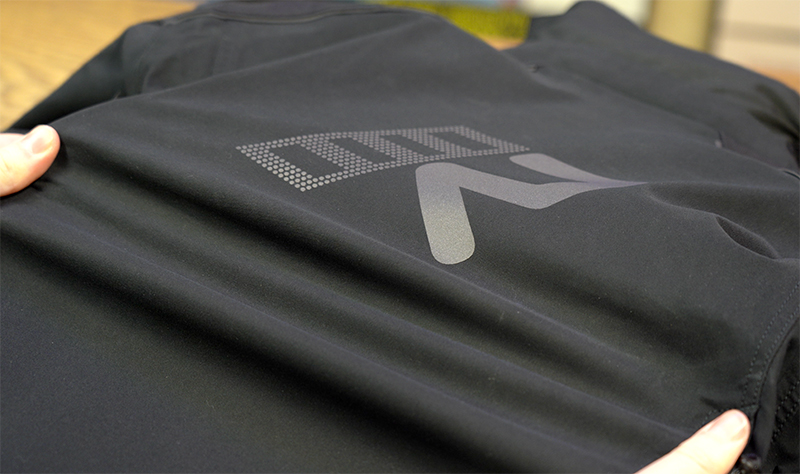
But we do think the new Nivala's outer chassis is potentially more stretchy than the old one's. We pulled on the fabric at the back of the jacket; and there was definitely more stretch in that area on the 3 than on the 2. That's not conclusive, obviously; and Rukka isn't making any claims about an increase in comfort, so we may be imagining this. But the 3 certainly doesn't seem to signal a retrograde step in this regard.
There are quite a few detail changes between the Nivala 2 and the Nivala 3.
The most significant, in my view, relates to venting.
The 2 had two vents in the shoulders, two in the biceps, two up the flanks and two across the back.
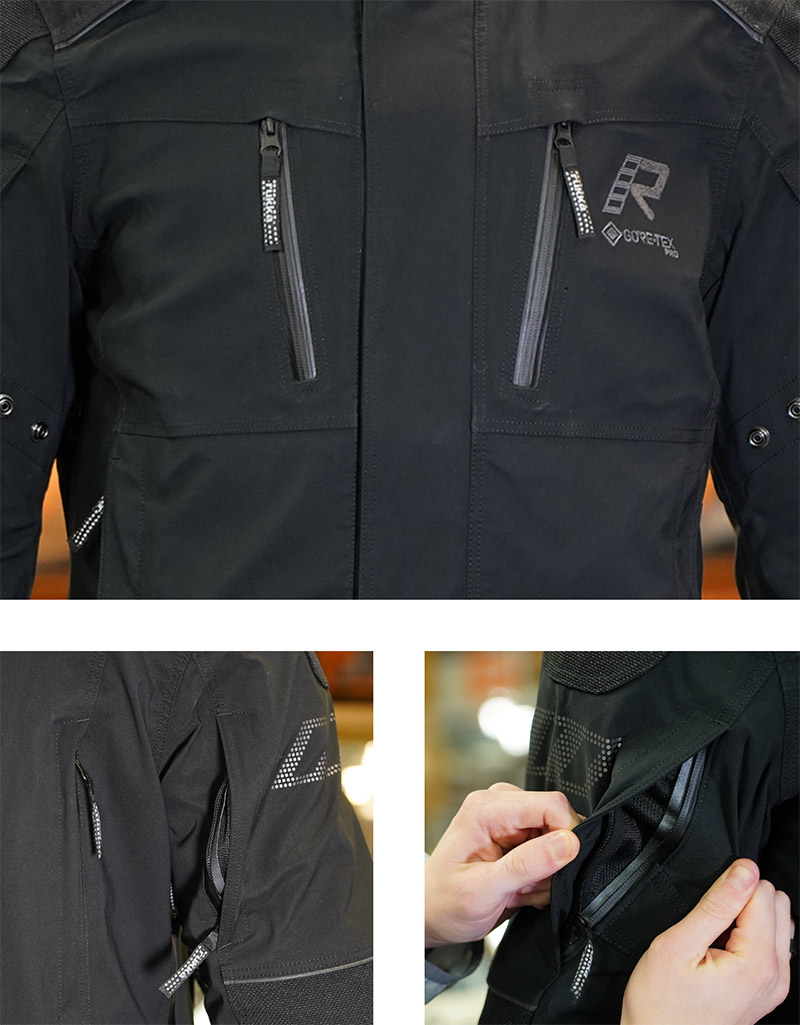
In addition, the 3 has two vents on the chest, and outgoing in addition to the incoming vents on the biceps. So yes it is better vented.
I don't think anybody buys a Rukka jacket because of the venting. As a brand, Rukka is about the cold and the wet, rather than the warm and the dry. But extra vents are extra vents, so no arguments from us here.
Some years ago Rukka got hacked off with people asking for replacements for lost storm collars. They came in lots of sizes, and Rukka could never replace them, so they came up with the brilliant idea of sewing them permanently into the jacket's neck.
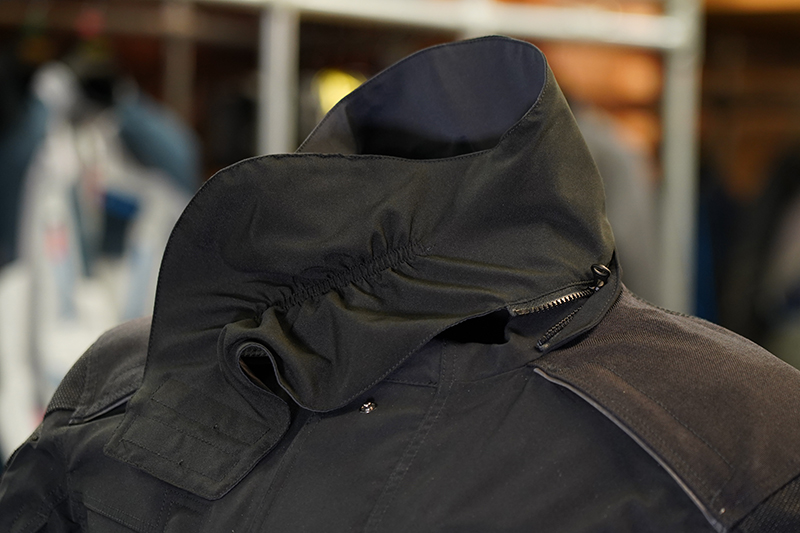
At the time, they declared it was to combat the worldwide epidemic in neck collar thefts! Nobody believed a word of it, but concealing the storm collar in the neck was a mistake. It had a tendency to make the jacket's neck collar too tight. It put some people off buying the Nivala. Although where somebody really wanted the jacket we often resorted to simply cutting the collar out.
Well, now the storm collar can be zipped on and off; and this time round Rukka can supply replacements, so if you lose yours, you no longer have to steal somebody else's!
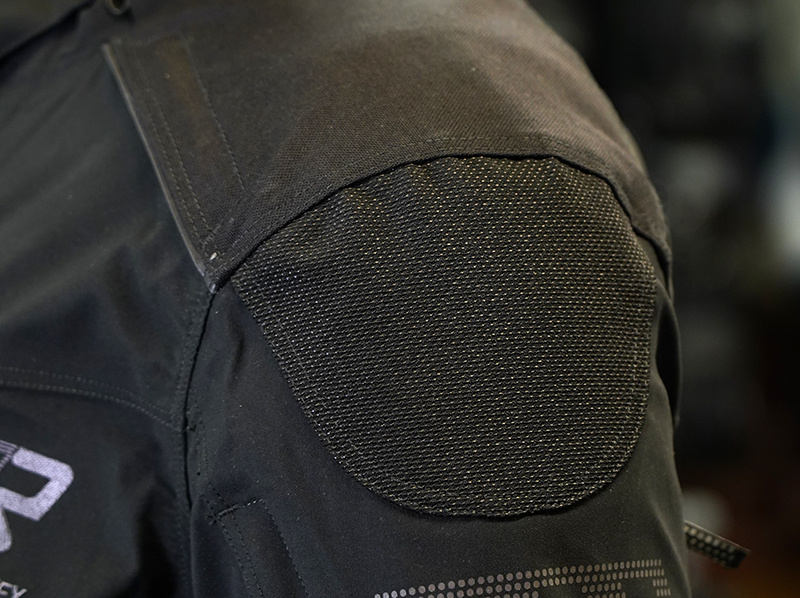
The 3 loses the Armacor panels on the shoulders and elbows. Armacor is an impressive material. It is very tear resistant, it is very abrasion resistant and it's very light. On the new jacket, the Armacor has been replaced with a combination of two different fabrics. There may be a good reason for this, but it looks a bit messy and less premium, in our view. Clearly, though, it’s up to the job.
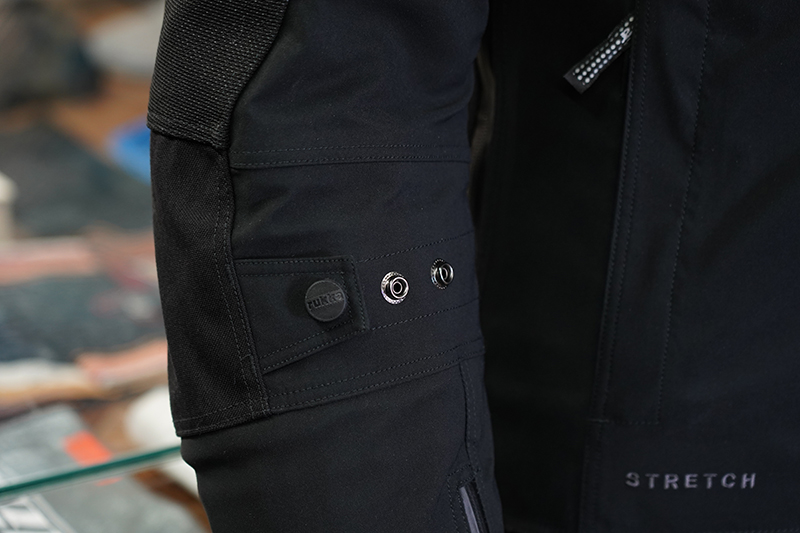
What you do get on the biceps and forearms are poppered adjusters. The old Nivala didn't have them. Not quite sure why Rukka felt a need to add them. What we would say is that the ones on the biceps can also be used to hold the vents open.
In terms of pockets, it’s a game of swings and roundabouts. The old jacket had two external, zipped, hand pockets, one internal one and a stuff pocket on the back. The new jacket has two external, zipped, hand pockets, no pocket on the back, but potentially two on the inside.
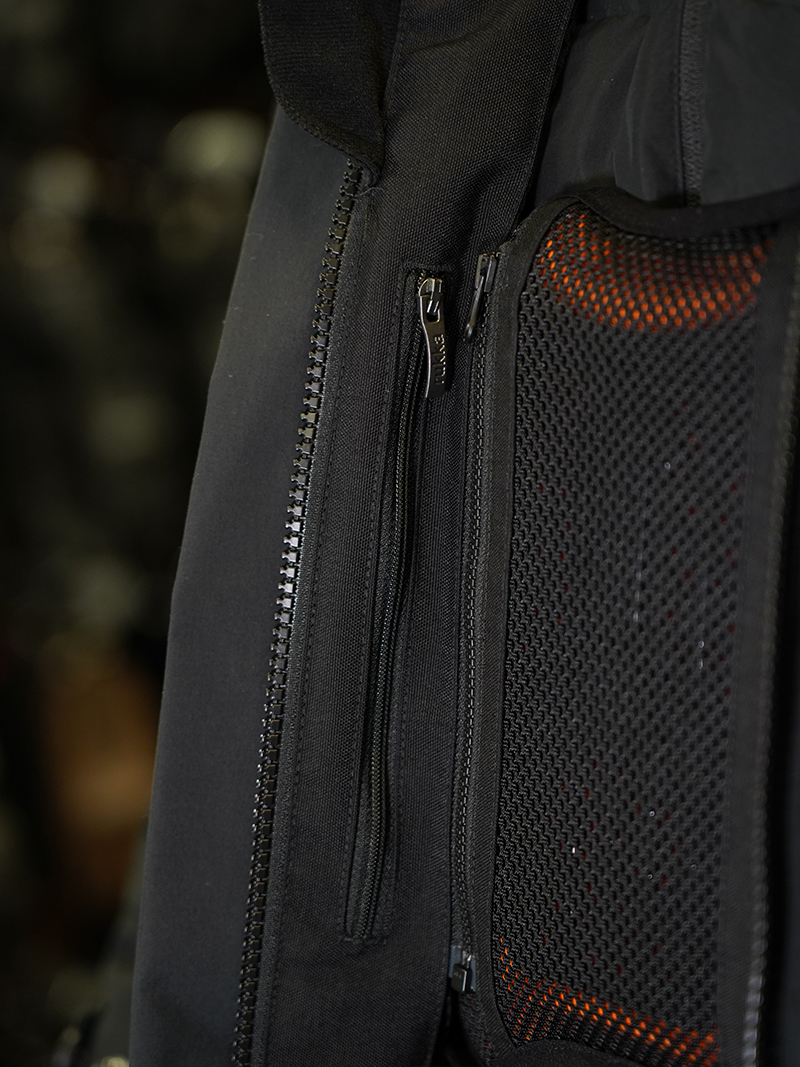
Now we have mentioned the one-piece, chest protector, but if you want a neater arrangement you can buy a two-piece, Level 2, chest protector, and fit the pieces into the internal pockets. Do this, though, and you will lose the ability to use them for storage.
But with the 3 you do get a credit card pocket at the bottom of the left sleeve; and such pockets are useful.
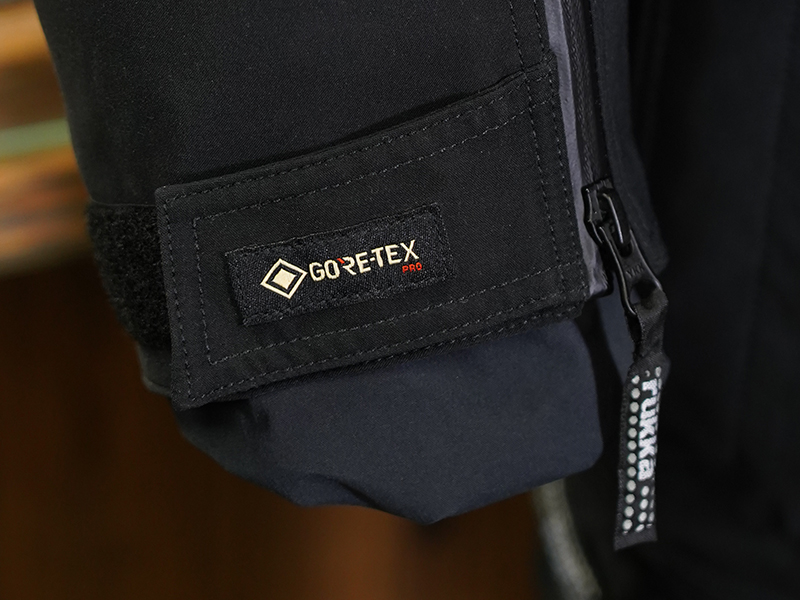
Like the 2 the 3 comes with Gore-Tex cuffs. We did initially think they didn’t feel as nice. They are not quite as stretchy, but actually it’s probably just that they’re a bit different, and not what we’re used to.
Other things that remain unchanged are zips and velcro flaps at the ends of the sleeves. A connecting zip. A crotch strap. And loads of hi-vis, reflective detailing.
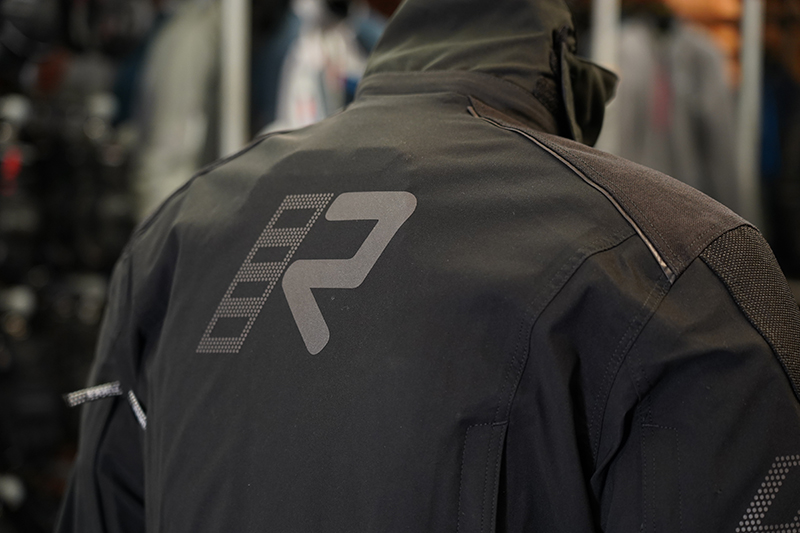
One thing that has found its way on to the back of the jacket is a largish Rukka ‘R’ logo. We have mixed feelings, as over the years we have spent too many hours arguing with customers over whether the ‘R’ rubbing off is a warranty issue or a ‘wear and tear’ one. If it happens after the first six months, it's the latter, by the way!
Now, the other big change is to the down-filled, inner jacket. This has always been an important part of the Nivala’s proposition. A heated jacket aside, a down jacket is the best way to insulate body heat on a motorbike. And the Nivala’s down jacket has always been a very good one.
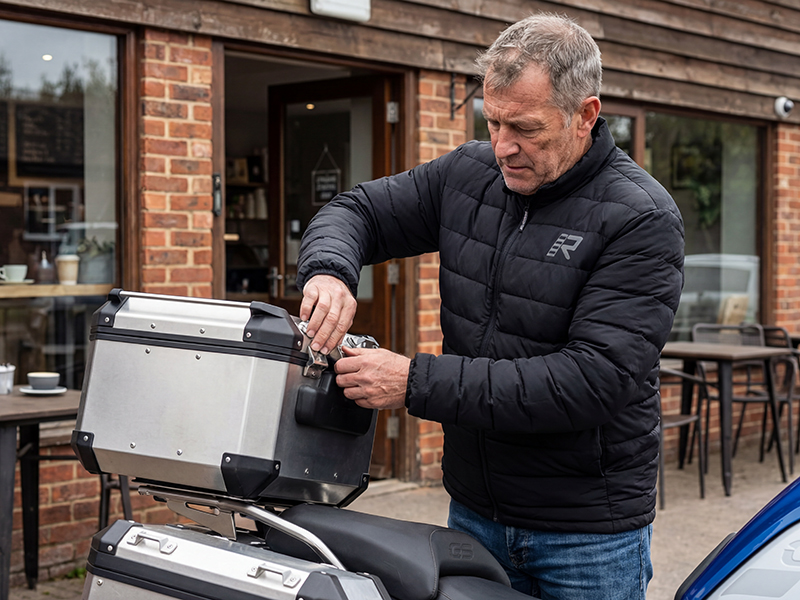
The latest one, called the DownRide-R, is terrific. One retailer has suggested that it contains more down than the old one, although we can find no evidence of that. What we do think is that the new one looks a bit nicer off the bike. The men’s version comes in three colours. And if you want the gold or the grey one rather than the black one, we’ll happily swap it over. Equally, if you don’t want the DownRide-R at all, we’ll buy it back from you, knocking £200 off the price of the jacket.
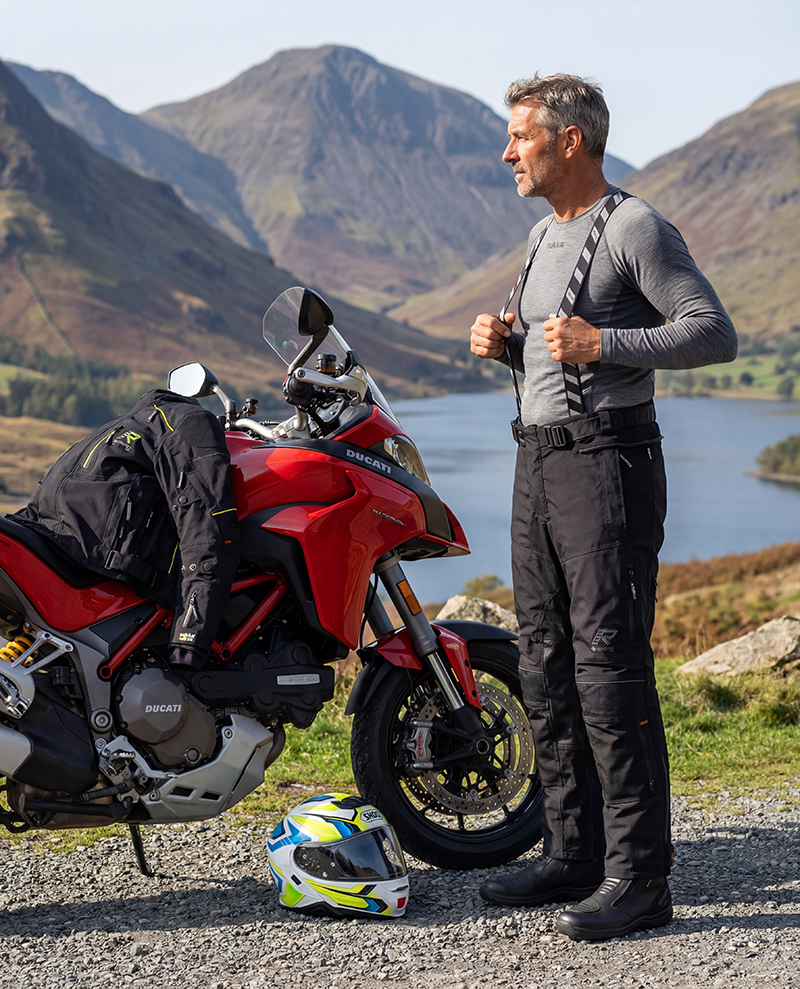
The Nivala 3.0 pant
In all substantive respects the trousers are similar to the jacket.
So the same stretch fabric. The same 3-layer, Gore-Tex membrane. The same single-A rating. The same, huge, level 2 armour.
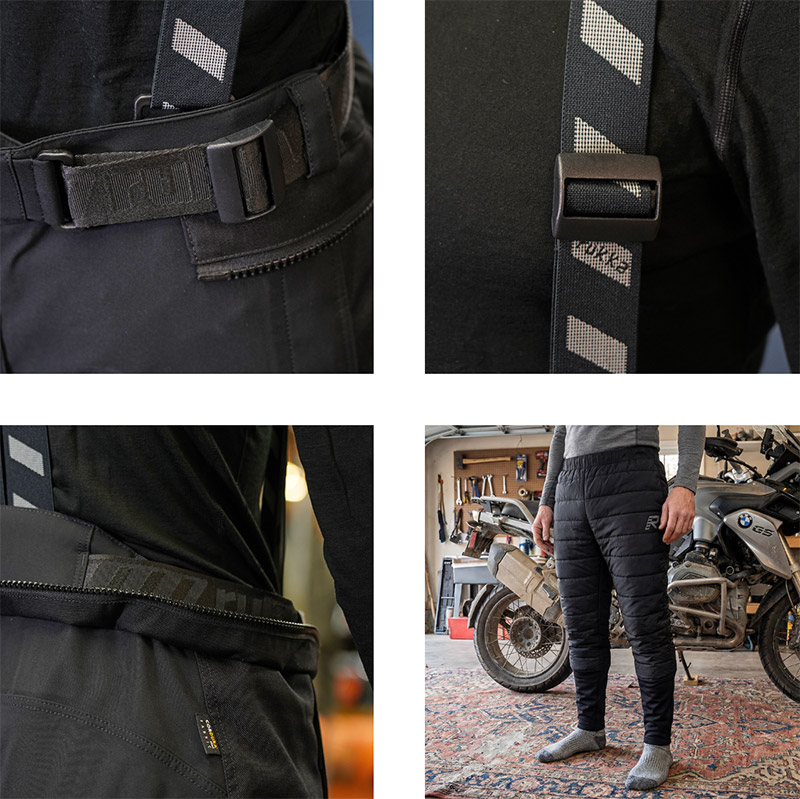
You get the same heavy-duty waist adjuster mechanism as you did in the Nivala 2 pant. The same Defence braces. The same connecting zip. The same down-filled inner pants that, again, we’ll buy back if you don’t want them. You’ll save £140 if you do this.
You get two zip pockets. An anti-glide panel in the seat and Rukka’s AirCushion system, again in the seat, for breathability. Leather panels up the insides of the legs. And abrasion-resistant panels on the knees and hips that are not Armacor.
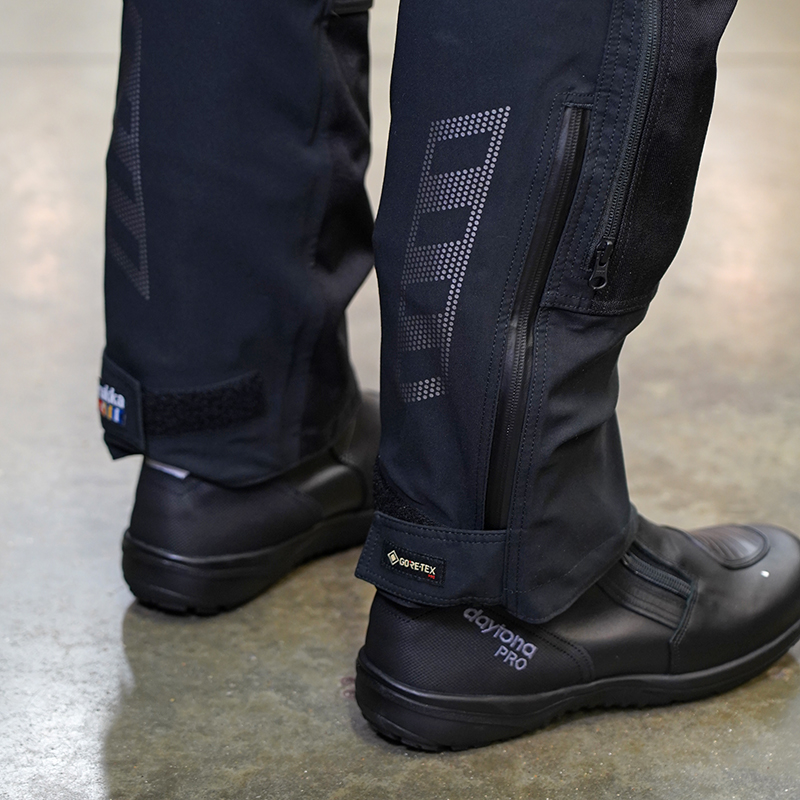
Obviously, there are long zips with Velcro flaps up the legs to help you to wear the pants over most taller boots. No touring boot will be any issue; ditto most crossover, adventure boots. A real, off-road boot might prove challenging, although this isn’t normally the kind of pant you’d wear with such a boot.
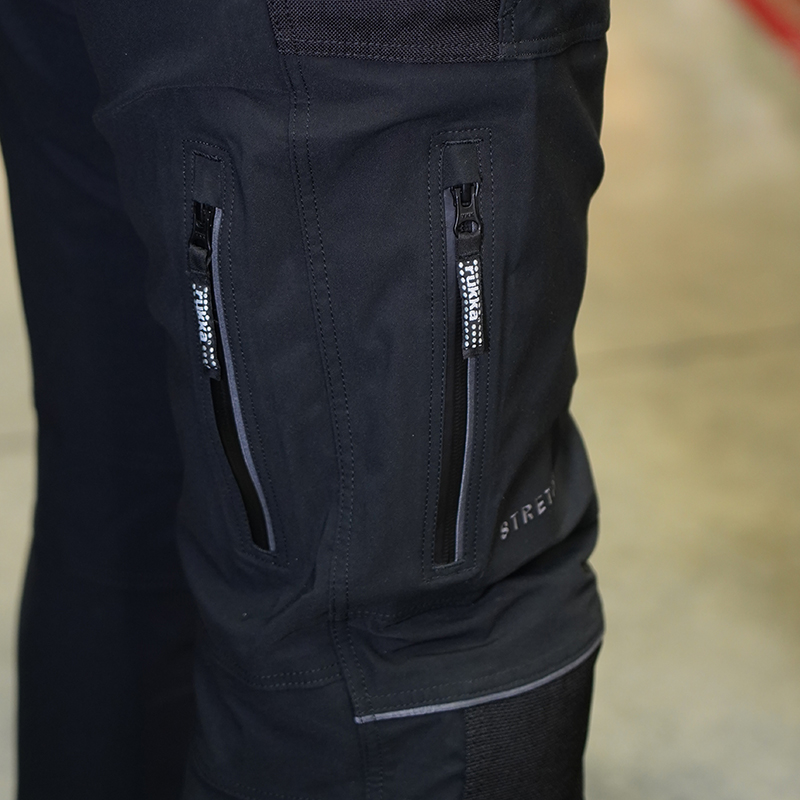
From what we can see, the only real upgrade is exhaust, as well as incoming, vents on the thighs.
Of course, one of the main differences between a Rukka pant and a Rukka jacket is the number of sizes the former comes in. The pants go from a 28” waist up to a 48” waist so, as with the jacket there are 11 sizes. But in most waist sizes the pants come in short, regular and long leg lengths.
With a Rukka suit, given the price, I would suggest that it’s always worth visiting a dealer to get the sizing right. We, I think, have a lot of experience getting Rukka gear to fit properly. But it’s particularly important with the pants. We know how they should fit, but the leg length can be an issue, particularly as the long variant is very long indeed. And the length of the leg has to be right to get the knee armour to sit where it should.
We will always aim to have all the sizes in all the leg lengths here in the shop at all times. Nobody else even attempts to do this. They’ll all order in for your follow-up visit, but you stand a better chance of getting it right first time if you come to see us in Guildford.
In summary
We have always rated the Nivala.
It is hugely comfortable, extremely waterproof, and with its down liners, very warm. We have no truck with those who complain about its CE rating. As we have explained, this is still one of the most protective suits money can buy. And, quite simply, if it was AA-rated it would be no more comfortable than the other, 3-layer Rukka suits.

The Nivala is not the right suit for everybody, and we still often get dismayed when we learn that somebody has bought one to go touring in. Unless you’re touring in somewhere like Scandinavia, Greenland, Iceland or Alaska, the Nivala will almost certainly not be the right suit. Some people think that if you spend enough you will get the suit that does everything.
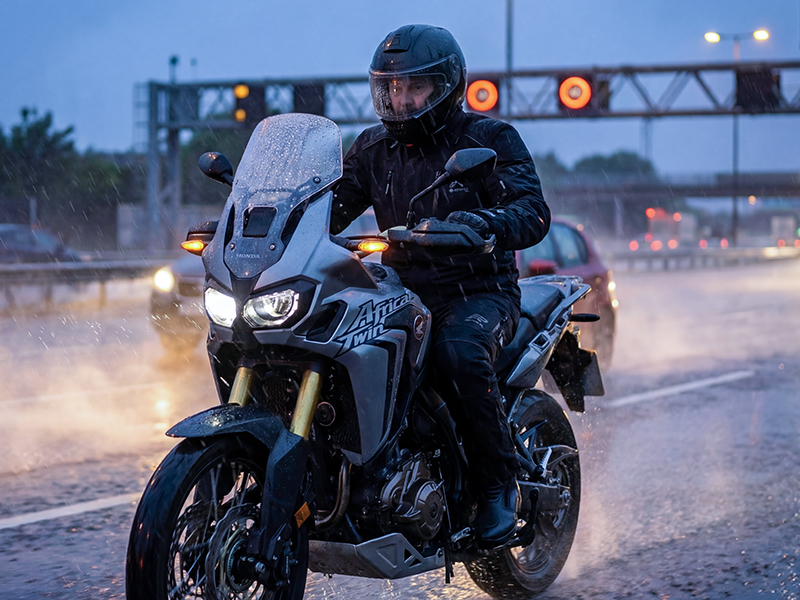
I’m afraid you won’t. And despite its upgraded venting you will need to accept that the Nivala is still more about the cold and the wet than the hot and the dry. It’s not what you want in the south of France, Spain or Italy. And it’s most certainly not what you want if you’re going even further south!
The truth is that the new Nivala doesn’t appear to be very different to the old one. It is, in most of the substantive respects, the same as the old suit.
We have spoken about the new membrane. The new suit will be just as waterproof. Truth be told we don’t yet understand the DWR implications. It may end up being not a big deal, but the reality is that we’re all going to have to get used to a bit more wetting out, whatever suit we buy.
In our book, the changes to the new Nivala 3 are all worthwhile. None of them changes the character of the outfit, but they nearly all represent marginal gains.
And given this, the increase in price of just over £100 over the old one seems incredible. £2600 is still a lot of money for a suit. But then again the Nivala really is a lot of suit for the money.
You can buy the Rukka Nivala 3 GTX suit with free next day UK delivery online, or visit our store in Guildford to try one on.


Share this story


