


















































What can I do about fogging on my Shoei Neotec 3 helmet
Published on: 10 February 2026
CLICK SHOEI NEOTEC 3 HELMET TO SHOP WITH FREE UK NEXT DAY DELIVERY
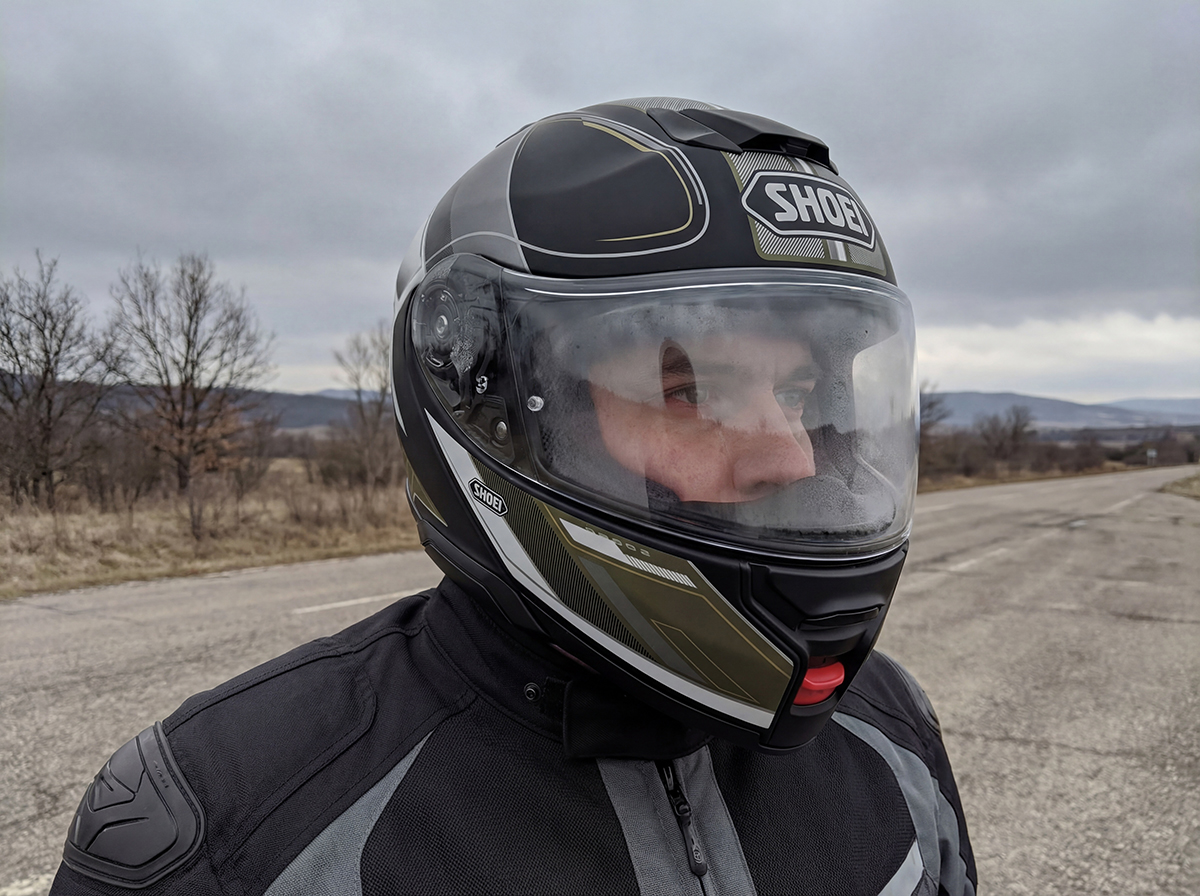
This is not an uncommon occurrence on the Shoei Neotec 3. There’s a good reason for it. There’s nothing wrong with the helmet. You just need to understand why it’s happening, and accept that it’s the price you pay for a helmet that, in theory, is quieter than other helmets.
To understand what’s going on, let’s take a step back.
Fogging or misting in a helmet is simply a manifestation of condensation.
Condensation is the water droplets that result when warm, humid air comes into contact with a cold surface. These droplets are tiny, and present themselves as an opaque film that is impossible to see through.
It’s the same as what happens when you get into your car on a very cold morning. When the warmth of your body and your moist breath come into contact with the windscreen, the cold glass turns the humidity inside the car into a coating of fog on the glass. The way to reverse this is to blow warm air from the car’s heater over the screen. This warms the glass. The difference in temperatures is reduced, and so quite swiftly the misting disappears.
In a motorcycle helmet it’s all down to your warm breath coming into contact with a cold, outer visor. It’s a particular problem in the winter months. It doesn’t tend to happen in the summer.
Technically, the remedy is to reduce the differential between the temperature of the air inside the helmet and the coldness of the visor that, in turn, is dictated by the external, ambient temperature.
You can achieve this temporarily by opening the visor for a few seconds to allow cooler air to enter the helmet. This may well improve the situation for a minute or so, but it will not necessarily cause the problem to go away completely. A few miles down the road you might need to do the same again.
There are a number of other things you can to do to mitigate the situation, however. You can open the chin visor if your helmet has one. The incoming, cooler air will obviously serve to reduce the temperature differential. And in some circumstances, in some helmets, this may be sufficient to overcome the problem.
Some helmets have what is known as a ‘crack’ position where you can ride permanently with the visor slightly open. The effectiveness of a crack position may well be dictated by the strength of a helmet’s detente position. Riding with your visor cracked slightly open will help reduce the fogging as, again, you would be allowing the cooler, oncoming air to reduce the air temperature behind the visor.
These days, of course, many helmets come with what is known as a Pinlock anti-fog insert that sits inside the outer visor, tensioned in place by means of plastic pins.
Now a Pinlock works in two ways. Edged with a band of silicone that runs around its perimeter, the Pinlock insert does not come into contact with the outer visor. And so it does not get as cold as the outer visor. Because it’s not as cold, there’s less chance of condensation forming on its surface when you breathe onto it. You might sometimes still see condensation around the edge of the Pinlock; but this is fine; it merely demonstrates that the Pinlock is doing its job.
But the Pinlock has another trick up its sleeve. The material the Pinlock’s lens is made from is hyrophyllic, and so it absorbs moisture, removing some of the humid air from behind the visor; and so again acting to reduce the problem.
There are different grades of Pinlock. There’s a 30, a 70 and a 120. This is a measure in seconds of how long it takes the Pinlock to become ‘saturated’ in the company’s in-house, test laboratory. A 120 Pinlock, therefore, is more effective at preventing fogging than a 70 or a 30.
At EICMA in November 2025, Pinlock debuted a new Pinlock 200 that, in theory, should be more effective at reducing fogging than the current best option, the 120; although as I write this we do not know whether there will be any trade off in terms of, for example, optical clarity.
So that’s a brief introduction into helmet fogging, what it is and how the issue might be tackled.
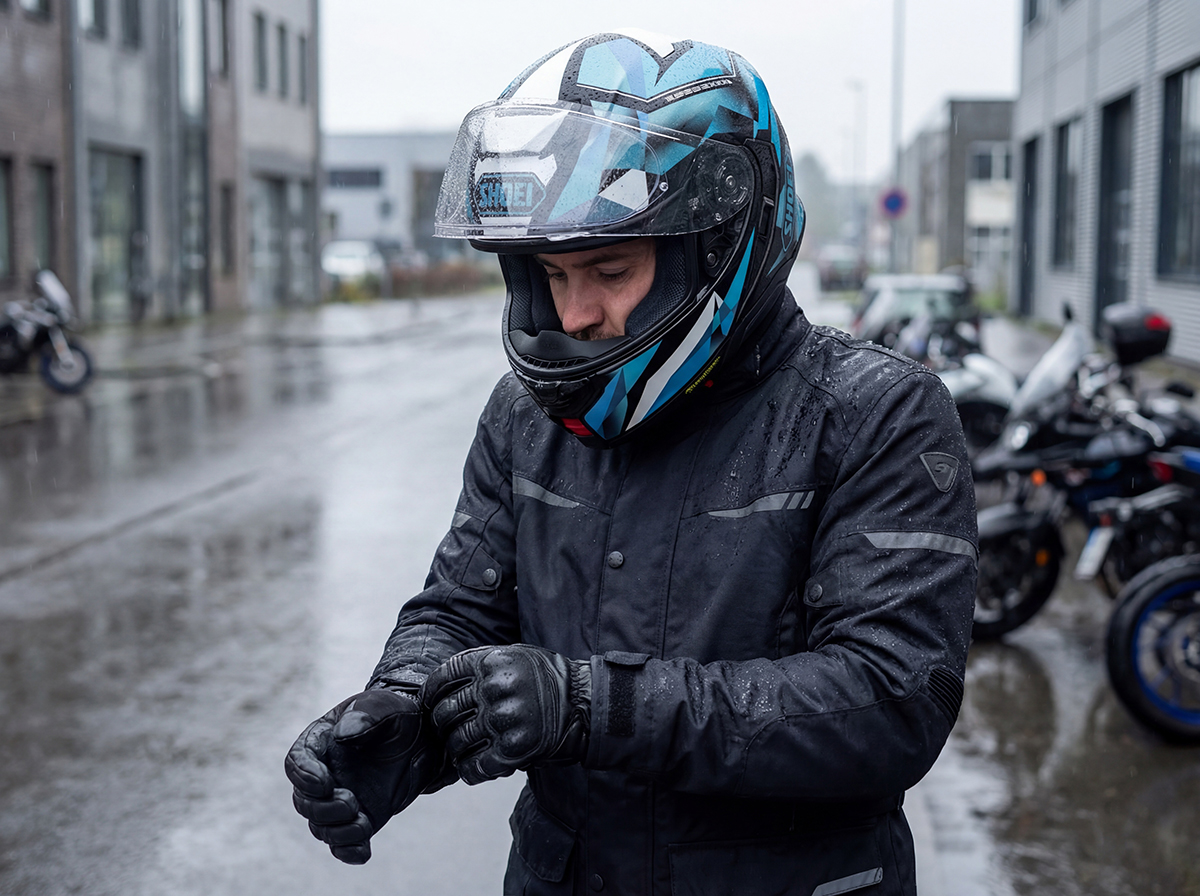
The problem with high-end, flip helmets like the Shoei Neotec 3
Now contrary to what old-school, sportsbike-infatuated, motorcycle journalists writing for publications like MCN would have you believe, the quietest helmets that money can buy are actually flip-lids. Specifically flip lids like the Neotec and its nearest competitor, the Schuberth C5.
This doesn’t mean that all flip helmets are quiet. But the way that we get into a flip-helmet means that it is possible to endow it with a neck roll that sits much tighter against the wearer’s neck.
And if the neck roll sits more snugly around the neck, that makes it much harder for the oncoming air to reach your ears. And it is this oncoming air that, at speed, is the single most significant contributor to noise.
You can see this for yourself if you close the chin bar on a flip helmet, and turn it upside down. In theory, you should not be able to get your head into the helmet because the aperture or hole is too small. But that’s not an issue because when you lift the chin piece you can slide your head into the helmet quite easily.
A full-face helmet, by contrast, has to have a larger aperture, because that’s the only way you can get your head into it.
The best way of demonstrating this, we have found, is to compare a Neotec 3 with its full-face cousin, the GT Air 3. And that’s because these helmets are identical in almost every respect other than that one is a flip lid; the other is a traditional, full-face helmet.
Look at the two, side-by-side, and you can see that the aperture on the Neotec is much smaller.
And so if you value quiet, you go for a helmet like the Shoei Neotec or the Schuberth C5 that has a similarly tight neck roll.
But with this advantage there comes a disadvantage; a disadvantage that comes to the fore when we’re talking about fogging.
Now keeping the air out of a helmet is good when it comes to reducing noise, but it’s less good when it comes to reducing condensation because if air can’t get into the helmet, it stands to reason that it’s difficult too for the warm and moist air behind the visor to escape from it.
And in cold weather, when fogging starts to present itself, what you really want is to expel the hot air. And with the kind of helmet we’re talking about here with a tighter seal around the neck that’s much harder.
So that’s why helmets like the Neotec 3 are more prone to fogging.
That is simply the way it is; and if you didn’t appreciate this when you bought the helmet that’s a pity. But whereas this is a problem that you will only encounter now and again when it’s cold, the upside is that you will benefit from the helmet’s extreme quietness every time you go out in it. Spring, summer, autumn and winter.
For most people that’s an acceptable trade off. A compromise that’s not difficult to live with.
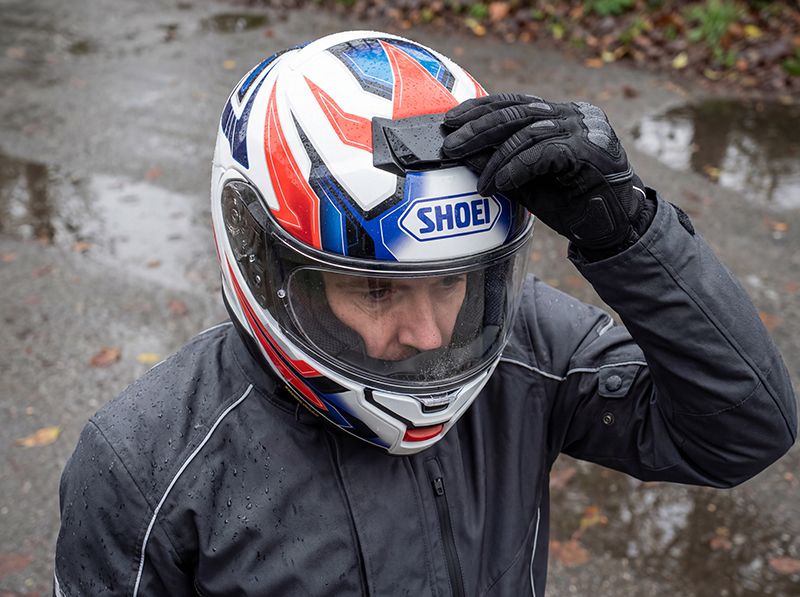
So what are the things you can do to mitigate the issue?
We’ve covered most of them, but let’s reiterate.
Make use of the helmet’s crack position. The Neotec 3 has one. I wouldn’t say that it was the best on the market, but it’s okay.
Open the chin vent. This will allow cooler air into the helmet. Inevitably this will reduce the temperature behind the visor.
Somewhat counter intuitively perhaps you should also fully open the brow vent. I say counter intuitively because if it’s cold out most people will not want to invite cold air to be directed over the top of their head. But as this incoming air passes over the head it will pull hot air from behind the visor, and expel it through the exhaust vent. It literally drags this warmer air out in its slipstream.
We’ve mentioned the Pinlock. It comes fitted, but to elongate its life some people don’t use their Pinlock in the summer.
When Shoei eventually gets round to offering a Pinlock 200, either as standard, or as an upgrade, that should help things immensely.
There’s one last point I would make.
If you ride a cruiser, or indeed any bike with a large screen, the fogging issue can be worse. Now not being exposed to the full force of the oncoming, colder air might mean that fogging is less of an issue to start with because you sit in a kind of isolating bubble that might protect you from the impact of the elements.
But the downside can be that it is very difficult to get cooler air into the helmet to overcome any fogging that does occur. And that’s because you won’t perhaps be exposed to the oncoming air. The only solution on a bike like this will often be to ride with the visor partially open. This will prevent any build up of heat behind the visor. And this should not be too much of an issue because your face and eyes should still be protected by the bike’s screen.
Anyway, I hope this explains why your Neotec 3 fogs up. There’s nothing wrong with your helmet. In fact we think the Neotec is one of the best, all-round helmets that money can buy.
It has but one failing. And that’s the one you were probably already aware of before you read this article.


Share this story


