
































































Motorcycle Helmets Explained: The Complete Guide | Motolegends
Published on: 26 May 2026
Most riders, even experienced ones, buy helmets on vanity criteria: the colour, the graphics, the price. And that's fine, up to a point. But your helmet is the single most important piece of protective equipment you will ever buy. Understanding even the basics of how it works, and how it can fail, could, on the right day, make all the difference.
How a helmet actually protects you
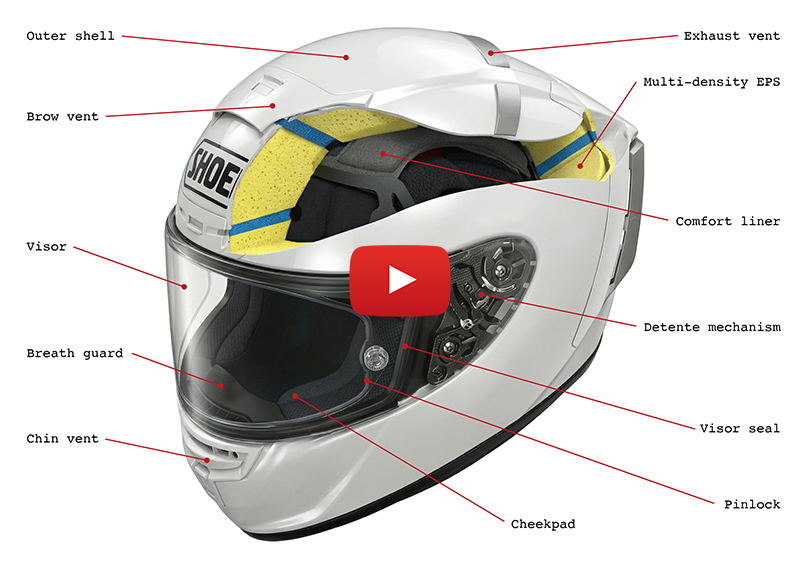
A helmet does two things. The outer shell, the bit that hits the road first, acts as a barrier against penetration and, critically, spreads the force of an impact around its surface. Thicker, harder shells do this more effectively, and also hold up better when there are multiple impacts in a single accident.
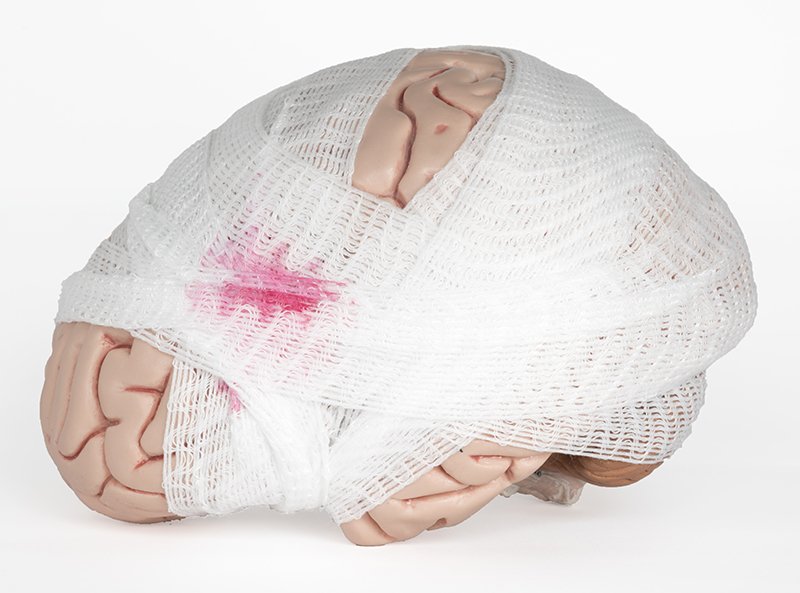
Inside the shell sits the EPS liner: expanded polystyrene, which is essentially a more sophisticated version of what protects your new television in its box. Its job is to absorb the energy of an impact before it reaches your skull. When your head hits something at speed, your brain, being somewhat jellylike, shoots across the inside of the skull and rebounds back again. If the force is severe enough, the brain collides with the bony interior of the skull and that's where bruising, haemorrhaging, and permanent damage can occur.
Once the EPS has been compressed in an impact, it won't spring back. It is done. Which is why any helmet that has been in a serious accident needs to be replaced, even if it looks fine on the outside. A better test than inspecting the shell is to look at the EPS itself: if the painted surface is cracked and the white polystyrene shows through, the helmet has been compromised. Walk away from anyone offering to X-ray a helmet to assess its safety, X-rays can only examine the outer shell, and that person does not know what they are talking about.
Premium helmets tend to use multi-density EPS, layers of different densities that respond appropriately to both high-speed and low-speed impacts. A denser, harder EPS absorbs big impacts well but does a poor job with smaller ones. And don't dismiss low-speed impacts as trivial: you can damage your brain in a car park fall. A softer layer closest to the shell handles the minor stuff; a harder layer beneath deals with the serious business.

Shell materials: what the marketing doesn't tell you
Helmet shells come in four broad types. Polycarbonate (plastic) shells are the most basic. They can meet ECE 22.06, the mandatory safety standard, but they need to be thicker and heavier to do so, and they don't cope as well with multiple impacts.
Fibreglass shells are stronger and therefore lighter, but still considered fairly basic in terms of technical construction.
Composite shells, fibreglass reinforced with carbon fibre, Kevlar, or other organic fibres, represent the sweet spot. This is the construction favoured by Shoei and Arai, and by most serious premium brands, even if each calls their version something more exotic.
At the top of the tree sit pure carbon shells. They are lighter, but here's what the marketing won't always admit: they do not offer extra protection. If you are a MotoGP rider, the weight saving may have genuine sporting value. For your average road rider, a carbon shell adds little. It can also make a helmet noisier, and if you use integrated comms, a carbon shell will significantly reduce the communication range.
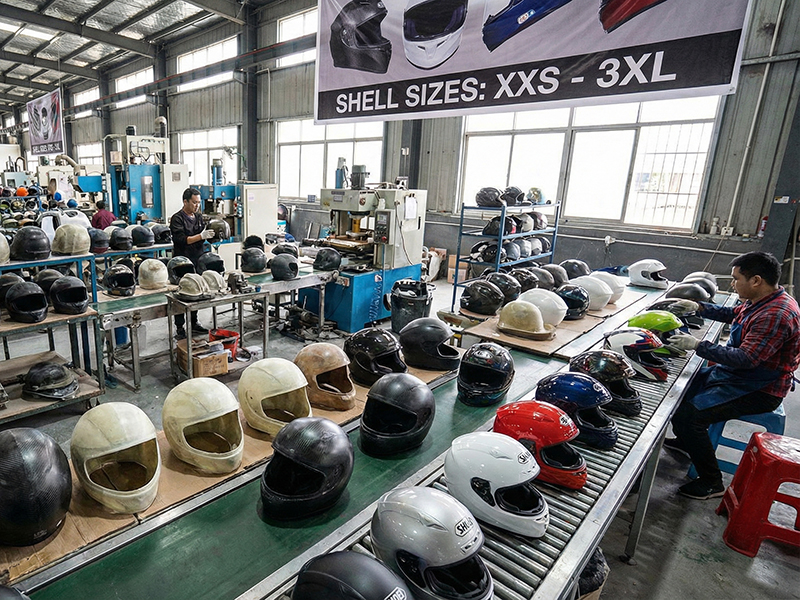
Shell sizes: more than you might think
Helmets come in multiple shell sizes to accommodate different head circumferences. A basic helmet may come in just one shell size, and that compromises both fit and appearance. Two shell sizes is still considered suboptimal. Premium helmets offer at least three, and sometimes four. More shell sizes means a closer, more proportional fit.
A word of warning about helmets that offer four or even five shell sizes purely for aesthetics: a helmet designed to sit unnaturally close to the skull looks sleek but will not protect you as it should.
Form over function is always the wrong trade-off when it comes to head protection.
Fit: the thing most retailers don't want to talk about
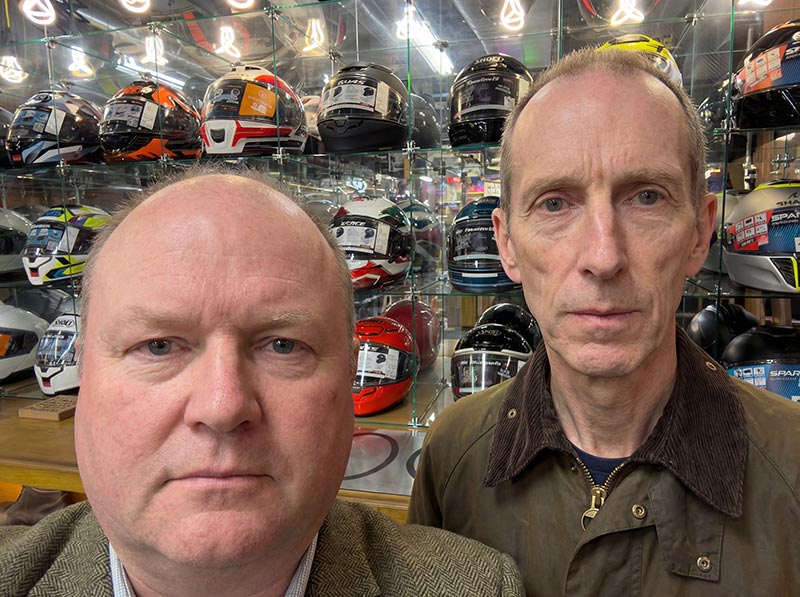
Getting a helmet to fit properly is not just about measuring your head. Two riders with identical circumferences may have heads of completely different shapes, one long and oval, one wider and rounder. And every helmet has a different internal architecture.
Any helmet that causes discomfort anywhere is unacceptable. It is almost never the helmet's fault. It is the wrong shape for your head, or the wrong size, or both. A fit that is too tight will cause headaches. A fit that is too loose will move around at speed, generate more noise, create visual disturbance, and, most importantly, fail to absorb impact energy in the way it was designed to.
Premium helmets address this with adjustable liners and cheek pads that can be swapped for thicker or thinner versions to dial in the fit. Those little red straps attached to the lower edge of the cheek pads are EQRS (Emergency Quick Release Straps): pull them and the cheek pads come free, making it easier for first responders to remove the helmet safely.
When it comes to achieving a genuinely precise fit, Shoei has, for as long as we can remember, been ahead of the game. Every helmet they make is available with three different crown liner thicknesses and three cheek pad sizes, a combination that can make a profound difference. Very few retailers stock all these options, which is a shame, because they are free of charge.
Better still is Shoei's Personal Fitting System (PFS). Retailers who are approved PFS dealers measure your head in multiple dimensions using specialist Shoei tools, then feed those measurements into the Shoei app, which creates a virtual 3D model of your skull. The software then specifies exactly which pads to fit, and where, from a library of dozens of pads in different shapes, thicknesses, and densities. No fitter, however experienced, can replicate what PFS achieves, because no fitter can see what's happening inside the helmet the way the software can. It takes about 15 minutes, and if you haven't tried it, you should.

Safety standards: ECE 22.06 and why it's not the whole story
All helmets sold in the UK and EU must meet ECE 22.06, the standard that replaced ECE 22.05 in 2023. The new standard demands a higher level of energy absorption across more impact points, introduces testing for angled impacts (which can cause rotational brain injury), and applies more rigorous tests across a wider range of scenarios. If you encounter an ECE 22.05 helmet, whether online or in a shop, we would strongly advise against buying it, whatever the price.
In America, the applicable standard is DOT, which is considerably less stringent. You cannot legally ride in the UK in a DOT-only helmet. There is also the Snell standard, which in certain respects is more demanding than ECE, but was originally developed for car racing and does not reflect the type of impacts motorcyclists typically experience.
You may also have come across Sharp, the UK's voluntary helmet rating scheme. We have mixed feelings. Sharp has, on more than one occasion, awarded its highest rating to budget plastic helmets over premium helmets from the likes of Arai, an outcome that many in the industry find difficult to take seriously. Sharp's methodology has never been peer-reviewed, and it is not endorsed by any of the helmet manufacturers or any other official testing body. Take their ratings with caution.
The key point is this: ECE 22.06 is a pass mark, not a quality guarantee. A £150 plastic helmet and a £600 Shoei have both passed the same test, but they are not equally protective. Premium manufacturers test to a far higher standard internally, and continue to batch-test helmets as they come off the production line. Every single Arai helmet, for instance, is individually inspected by hand seven times before it leaves the factory. The £49.99 helmet reviewed enthusiastically in the pages of a motorcycle magazine is not as protective as a premium alternative. Anybody who tells you otherwise is either mistaken or being economical with the truth.
We understand that not everybody wants to spend £500 on a helmet. But if there is one area where cost-cutting carries genuine risk, this is it. A cheap helmet could, on a bad day, turn out to be the worst value purchase you ever make.

Fogging: why it happens and what actually helps
Fogging is one of the most common complaints we hear. Cold visor surface, warm breath inside the helmet: the warm humid air condenses against the cold outer visor and visibility disappears. It is not a helmet defect. It is physics.
Ironically, fogging is worse in better helmets, particularly high-quality flip lids like the Shoei Neotec 3 or the Schuberth C5, where the tighter neck seal stops air entering from below, which in turn makes it harder to clear warm air from behind the visor. The seal that keeps a helmet quiet is the same seal that makes fogging more likely.
There are three things that help.
First, venting: opening both the chin vent and the brow vents simultaneously draws cold air in and drags warm air away from the face. In extreme conditions you may need to crack the visor briefly for a blast of cool air.
Second, a Pinlock insert: a secondary lens that clips behind the main visor using pins, sealed around its perimeter with a silicone bead. Because the Pinlock sits slightly away from the outer visor, the surface your breath reaches is warmer than the outer visor's surface, reducing condensation. The Pinlock material is also hydrophilic, it absorbs moisture, which further reduces fogging.
Third, a chin curtain helps keep cold air from entering at the neck and driving warm air upward toward the visor.
Pinlocks are graded by numbers that reflect their moisture-absorption capacity. The current top grade is Pinlock 120; a Pinlock 200 is coming in 2026. A helmet that ships with no Pinlock insert, or with a Pinlock 30 or 50, tells you something about how seriously the manufacturer takes your comfort and safety. If your helmet isn't at least Pinlock 120 prepared, corners have been cut.
One more thing on visors: drop-down internal sun visors are a very practical alternative to tinted outer visors. Tinted outer visors that block more than 50% of available light are technically illegal in the UK, and getting caught out after dark with a tinted visor is a situation best avoided. Always carry a clear visor, and the tools to change it.
Helmet types: what they're actually for
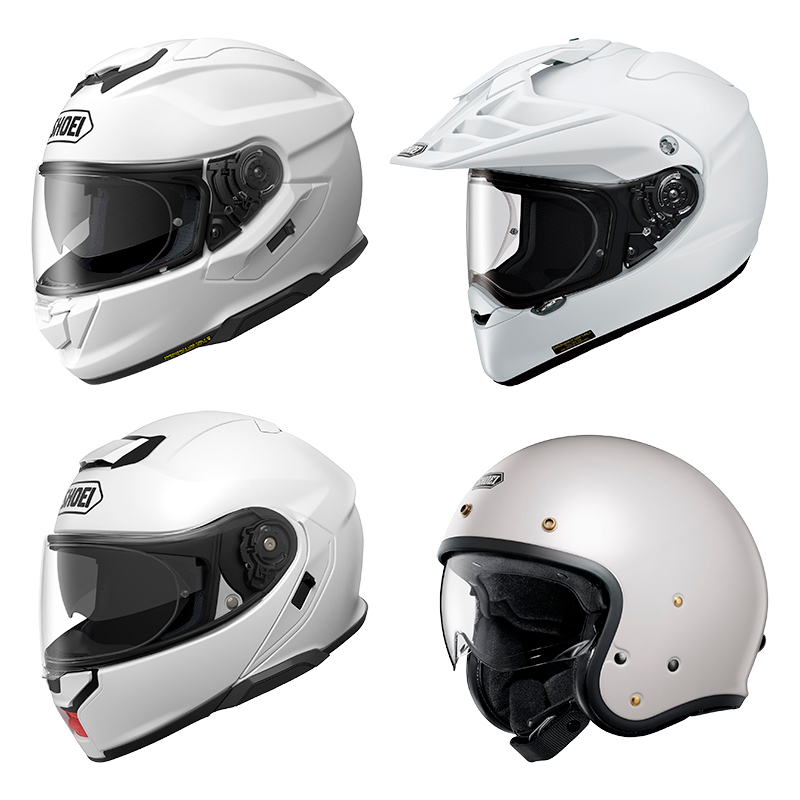
Full-face helmets have a fixed chin bar and offer the most comprehensive protection. They are the baseline for road riding.
Adventure helmets add an extended chin, a peak, and usually look the part on a GS or a Tiger. The peak has genuine utility off-road, it stops your goggles filling with mud from the rider in front, but on the road it mainly generates buffeting, oscillation, and noise. A piece of tape across the top of a standard visor does the same job. We ride adventure bikes ourselves, so we say this without judgement. But know what you are buying.
Sport-touring helmets are full-face helmets designed for a more upright riding position, often featuring a drop-down sun visor, something typically absent from race-oriented designs, which prioritise low weight and minimal bulk.
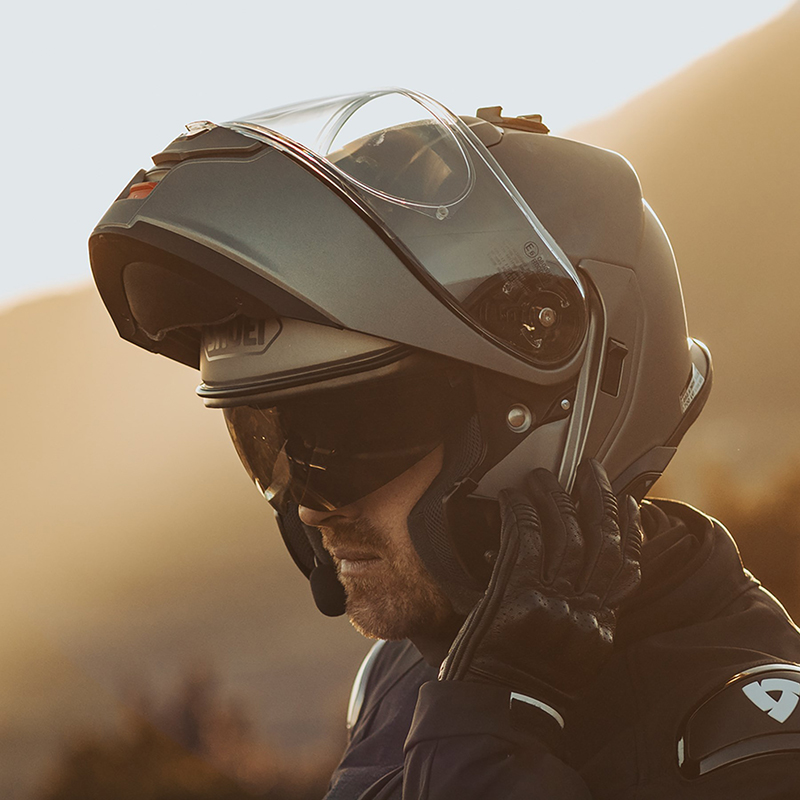
Flip-lid (modular) helmets come in two varieties. Flip-up helmets, like the Shoei Neotec 3, which is consistently the bestselling premium helmet on the market, have a chin bar that lifts up over the helmet. The chin bar's tight fit around the neck makes these among the quietest helmets available. Flip-over helmets, like the Nolan N100 or the Shark Evo, work equally well open or closed and are better suited to urban or short-distance commuting, though they tend to be less quiet at higher speeds. First responders, incidentally, prefer flip lids: they can check a downed rider's airway without needing two people to safely remove the helmet.
Retro helmets had a moment when the modern retro bike boom took off around 2014. Many of those early offerings were beautifully styled but practically useless: noisy, poorly vented, and about as waterproof as a sieve. Some are still sold. The ones worth considering, the Shoei Glamster, the Arai Concept-XE, are modern helmets in every meaningful sense. They just happen to look like old ones.
Open-face helmets look wonderful. We are not immune to the appeal. But come off the bike at even low speed and you will do serious damage to your face. We have never quite reached the point of refusing to sell them, but if you came to the shop we would usually try to steer you elsewhere.
Comms: a few things worth knowing
The two established comms brands to trust are Sena and Cardo. Interphone is also reliable, partly because their units are Sena-powered. The two main brands are not interoperable, you and your riding companions will need to standardise on one or the other.
Bluetooth is sufficient for most riders: connecting to your phone, talking to a pillion, or riding in a group of up to four. Mesh extends the group size and reconnects more reliably when riders drift apart. The newest technology, Wave (Cardo's implementation), uses your mobile signal as a relay when riders go out of range, effectively removing any meaningful distance limit.
One important point: attaching a comms unit to a helmet using a clamp or adhesive pad technically invalidates the helmet's homologation. The only way to be certain your helmet performs as tested is to use an integrated comms system. They are the future, and they generate less wind noise too. And if you buy your comms at the same time as your helmet, which is worth doing, the 20% VAT on the comms unit can be deducted from its price, since helmets are zero-rated.
Cheaper gloves, cheaper boots, a cheaper jacket even, we understand. But a cheaper helmet? We would push back on that, and not because we don't sell budget helmets (we don't, as it happens, but that is a coincidence).
The difference in cost between a budget and a premium helmet is not as large as people often assume, and what that margin buys, better shell construction, more sophisticated EPS, more precise fit, and a substantially higher internal testing standard, is not trivial. It may, one day, turn out to be the most important purchase decision you ever made.
Browse our full range of helmets here.
Frequently Asked Questions
Why is my visor misting up even with a Pinlock fitted?
A Pinlock reduces fogging, it does not eliminate it. Ventilation is essential. Open both the chin vent and the brow vents simultaneously in cold or wet conditions, and use the crack position on the visor if needed to let cooler air in.
What Pinlock grade should I look for?
At minimum, Pinlock 120. Anything less is a compromise. Look out for the Pinlock 200 arriving in 2026.
Are flip-front helmets less safe than full-face helmets?
There is no evidence to suggest they are. Modern flip lids meet the same ECE 22.06 standard. If anything, the emergency services find them preferable precisely because access to the airway is quicker and easier.
Why does my new helmet fit differently from my last one?
Because different brands, and different models within the same brand, have different internal shapes. Head circumference tells you very little on its own. What matters is the shape of your skull relative to the shape of the helmet.
Is it normal for the helmet to feel tight when I first try it on?
Some initial snugness is expected, the liner will compress slightly with use. Pressure points that cause pain are never acceptable and will not resolve themselves. If anything hurts, it is the wrong helmet for your head.
What is Shoei PFS?
Shoei's Personal Fitting System. Approved dealers measure your head using specialist tools, generate a 3D model of your skull, and use Shoei software to specify exactly which internal pads to fit and where. The result is a level of fit precision that no human fitter can match by eye. It takes around 15 minutes and is free.
Can I use anti-fog spray on a drop-down sun visor?
Internal sun visors typically lack anti-fog treatments. Some aftermarket sprays may help, but results vary. The main answer to fogging on an internal visor is airflow management.
Should I buy a carbon helmet?
Only if you have a genuine performance reason to want the lightest possible helmet. Carbon does not offer additional protection, only reduced weight. It can also increase noise levels and significantly reduce the range of an integrated comms system.
What are EQRS straps?
Emergency Quick Release Straps, the small red tabs on the cheek pads of premium helmets. Pull them and the cheek pads detach, making it easier for first responders to remove the helmet safely after an accident.
What are the main helmet types?
Full-face, modular (flip-up or flip-over), adventure, sport-touring, off-road, retro, and open-face. Each suits a different type of riding. If in doubt, a well-fitted flip-up helmet is arguably the most versatile option for road riders.


Share this story


