Motorcycle Gear Guides & Reviews
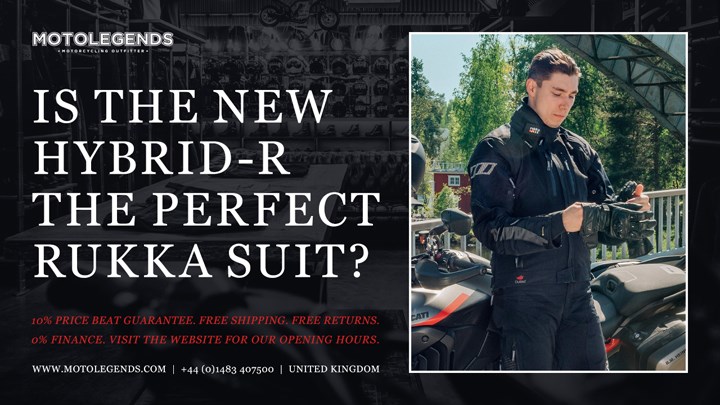
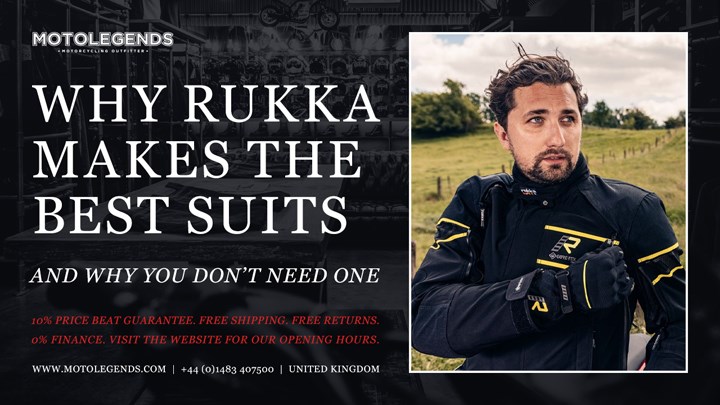
The Hybrid-R suit from Rukka came on to the market in January 2025. You will find it in some shops, and on lots of websites. There you can check out the details. Some retailers have written blogs about it, and even produced videos about it. And in these they will undoubtedly have listed all the features of the new suit. But what they won't have done is explain exactly what the Hybrid-R is, how it got its name, why Rukka produced it, what’s different about it, and who they produced it for. And so that's what we are going to do here.
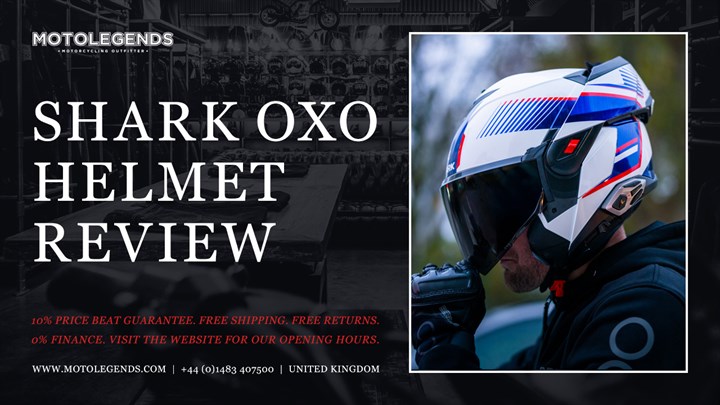
In response to a recent video review we did on the Shark OXO helmet, a customer challenged us by asking what had changed. Why were we now offering helmets whose internal parts were not changeable for a more customised fit, having banged on about how important custom fitting was to us? And I have to say that he's got a point. But the truth is that, whilst we sell a lot of Shoeis, we need a less premium offering, because not everybody can afford to spend £500 or more on a helmet.
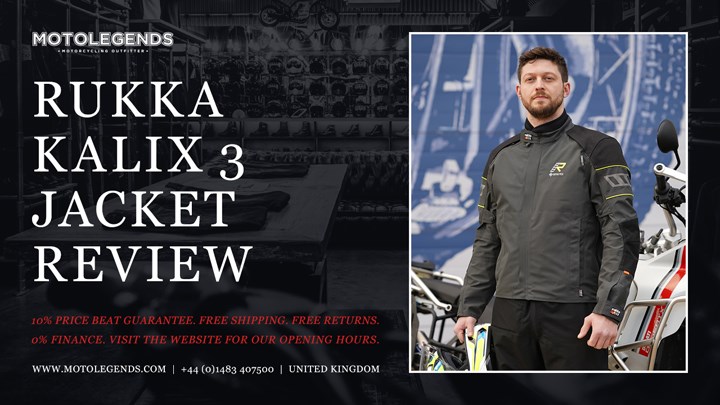
Everybody knows Rukka. The gear they make is not necessarily for everyone, but if you're going to be finding yourself doing a lot of riding in the cold and the wet, then it's got to be admitted that nobody does it better. The gear is beautifully made. Equipped with the very largest, Level 2 armour, Rukka's suits are also particularly protective; even those that are only A-rated for abrasion resistance.
I think it would not be unfair to suggest that the style of helmet that Shark is most famous for is the 'flip-over' helmet. I feel sure that the company's head honchos would like to believe that they are better known for their high-end, sports helmets. After all, they have been into racing from the very early days. Carl Fogarty wore a Shark when he won world championships for Ducati back in the nineties. And certainly the company seems inordinately excited by its latest Aeron GP helmet with 'adaptive' flaps to reduce drag at speed.
Back in the day, we used to produce catalogues every month. All our communications are digital these days, but we still love the look of a traditional catalogue. I suppose that what follows is about as close as we're going to get. Anyway, we enjoyed putting this ersatz Christmas catalogue together. We hope you enjoy it, in an old-fashioned, cosy, reading by the fireside kind of way.
Today I am going to broach the thorny, not to say dangerous, subject of warranties on motorcycle clothing. Now this could be just about the dumbest blog I have ever written. And that's because nobody is going to want to hear what I have to say. Not the manufacturers. Not the distributors. And not, I suspect, many motorcyclists. But that doesn't mean that there are not things that need to be said.
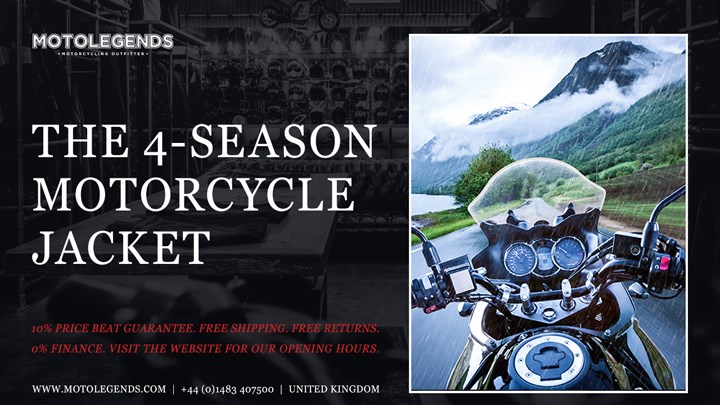
No motorcycle suit does everything. Some people think that if they spend enough they will be able to avail themselves of an outfit that will work in all weathers. Unfortunately, this particular Holy Grail does not exist. Any motorcycle clothing with a waterproof membrane will start to become very uncomfortable once the thermometer hits 25 degrees. Same applies in a situation where you are working hard off road, and generating your own heat.
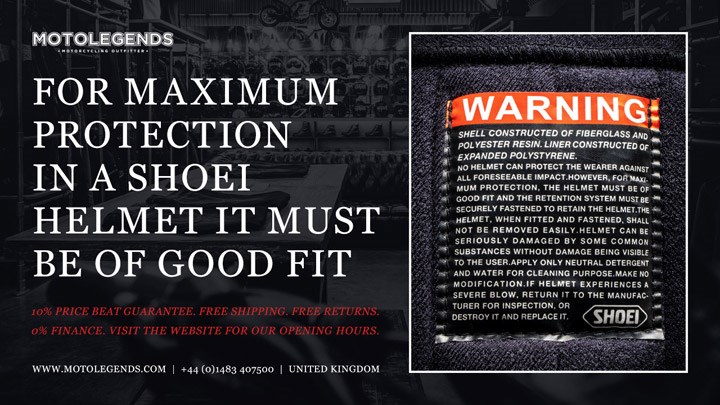
Now, inside every Shoei helmet, there's a label; and that's the label above. And one of the things this label is telling you is that if a helmet is to do its job properly, it has to fit properly. To us here at Motolegends, this seems pretty obvious. And that's why we have always gone to such lengths to get the fit right on customers' helmets. But not everybody realises how important the fit is. And that may explain why we seem to see so many people in the shop with helmets that are just wrong for them.
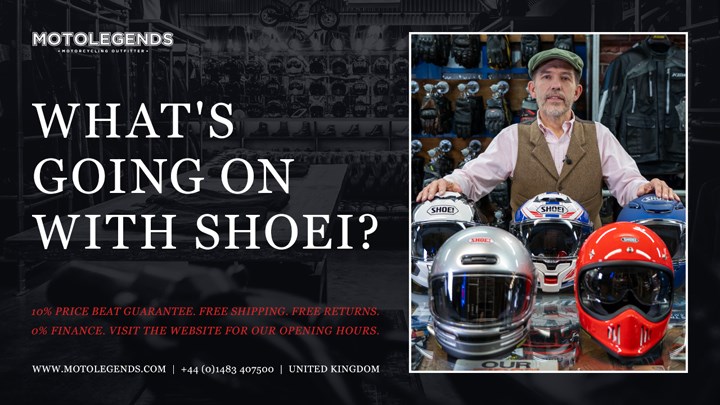
Review of the 2025 Shoei helmet collection. What Shoei helmet models there are, what motorbike riders they are designed for, and the pros and cons of each of them. Watch the video or read the review and then buy from leading Shoei retailer Motolegends.
Nobody doubts the fact that, right now, all the growth in motorcycling is coming from the adventure sector, and the reasons for this are manifold. The adventure bike is the bike that can do anything. You can commute on an adventure bike; in fact, there's probably no better kind of bike for the job. A modern adventure bike is a lot of fun if you just want to go out for a quick blast at the weekend. And, of course, if you have ambitions to travel further afield, there's no bike more capable of covering the ground, more comfortable to be in the saddle of, or more able to cope with a mix of terrains.
As with most things in life, everything in motorcycling is a compromise. And so when it comes to riding the bike, everyone has to decide what’s most important to them. Buy a sportsbike, for example, and everyone will think you're an exciting and dangerous individual. But you'll scare yourself half to death, get back ache, and accrue speeding fines as though they’re going out of fashion. You will never be able to properly see what's behind you. And you'll have to master the art of trying to look cool whilst walking about in a leather suit that causes you to stoop like the hunchback of Notre Dame.
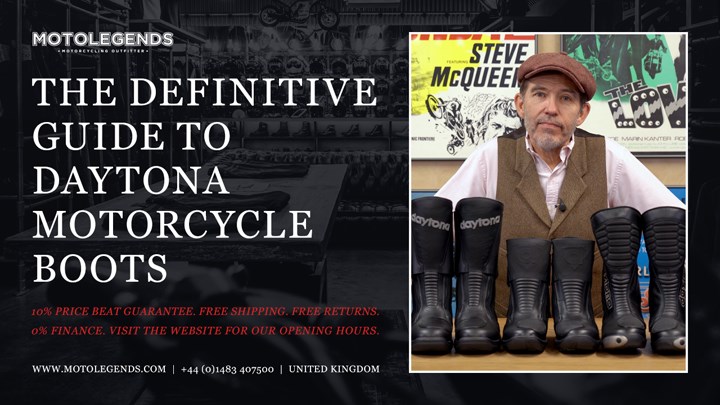
There are many boot manufacturers out there, and choosing the right boot for your requirements can be a little bewildering. Many people end up buying a boot at their local bike dealer because it seems to fit okay, and the guy in the shop said it was very popular. But if you're a serious rider putting in high mileage, and if you're looking for the highest levels of protection, comfort and durability then you've not done your homework if you haven't tried on, and looked into, a pair of Daytonas.
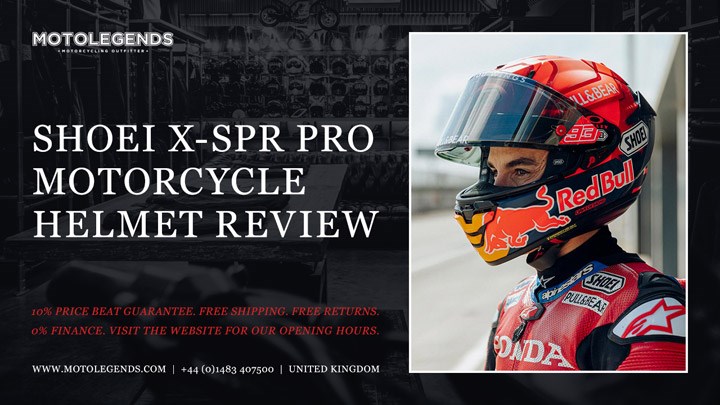
The X-SPR Pro is Shoei's race helmet. It's the helmet worn by their sponsored riders in series like Moto GP, WSB and BSB. It is designed specifically for racing, although Shoei always knew that it would also prove popular with deep-pocketed, sportsbike riders. Frankly, it is not the kind of helmet that you would expect Motolegends to be ranging. And indeed, even though the helmet has been on sale for a few years now, we have not offered it before. And that's because we're not really a sportsbike kind of company. We don't sell race leathers, even two-piece race leathers. We don't sell race boots. And we don't sell racing gloves.
The doors first opened at Shoei in 1959, although initially the company produced multi-purpose safety helmets. Their first motorcycle helmet was produced in 1960; just three years later they produced their first helmet for racing, although this was still an open-face helmet.
We did a video review some years ago about the best motorcycle helmets that money can buy. And it wasn't, for various reasons, difficult to conclude that the two brands that stood head and shoulders above all the other makers were Shoei and Arai. And we'll go over some of the reasons for coming to this conclusion in this article. Ultimately, we couldn't come to a definitive resolution, and so we copped out a little. Our verdict was that, whilst the two makers were in a league of their own, Arai clinched it from a protection standpoint.
Recently, we did a review of what we considered to be 10 of the best summer, motorcycle jackets. Our definition of a summer riding jacket being anything without a waterproof membrane. This being a necessity, obviously, to prevent overheating in warmer climes, or when you're working hard off road. And so we thought it appropriate to follow up that review with one about riding trousers that are similarly suited to hot-weather riding.
It's that time of year. Summer is technically here; although it still doesn't feel as though the new season is yet in full swing. But the temperatures are moving up. Occasionally, one might even suggest it's hot. Now that it's a bit warmer, more of us are venturing off road again. And lots of people seem to be setting off on adventures to foreign lands. And so a case can be made for putting your waterproof gloves in a pannier, and wearing a proper summer glove instead.
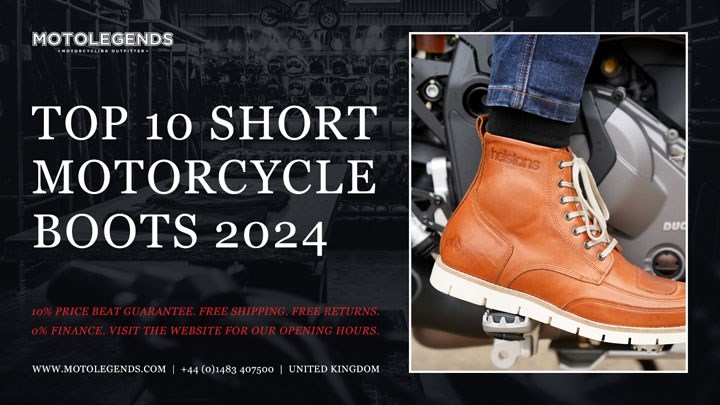
There can be no doubt that motorcyclists are turning their backs on full-height touring and commuting, motorcycle boots in favour of shorter, easier-to-wear, ankle boots. And it's not difficult to understand why. Now back in the old days, motorcycle boots were all tall. Whatever kind of bike you rode, whatever kind of riding you did, you bought a pair of calf-length boots. But that was when we all wore leather or textile suits. The bike might have been the only form of transport many people had, and not everybody was flush enough to have different riding outfits to match the conditions, or a stable of different bikes.
Based in the middle of Surrey, Motolegends is fortunate to be within an easy ride for many motorcyclists. If you live in Surrey, Hampshire, West Sussex, Berkshire or the western half of Kent you can probably be here inside 90 minutes at the very most. Of course, we're not far from the great metropolis either, although it's going to be an easier hike from west or south London than it is from north or east.
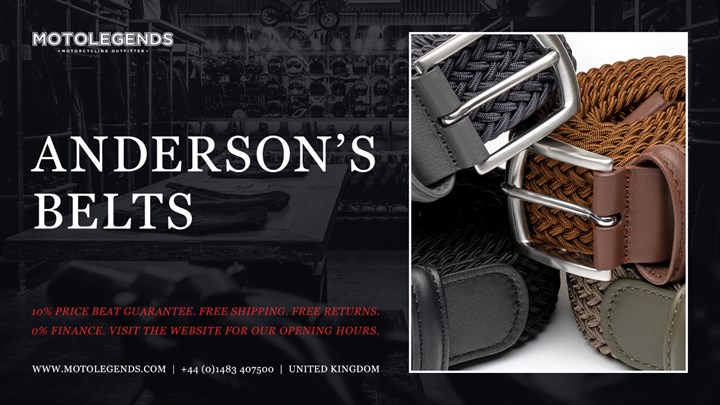
Long have I been convinced of the benefits of a stretchy, woven belt for anchoring a pair of motorcycle jeans at the correct height. Most motorcycle belts are thick and heavy leather affairs. They're consistent with the 'tough guy' aesthetic that many of us bikers, somewhat delusionally, still cling to.